The era of traditional local SEO is over. In 2026, when a homeowner experiences an emergency pipe burst at 2:00 AM, they aren’t scrolling through three pages of generic blue links to find a contractor. They are opening ChatGPT, Perplexity, or relying on Google’s AI Overviews (AIO), and asking a direct question: “Who is the most reliable, licensed emergency plumber near me?”
The AI does not return a list of ten websites. It returns one definitive answer.
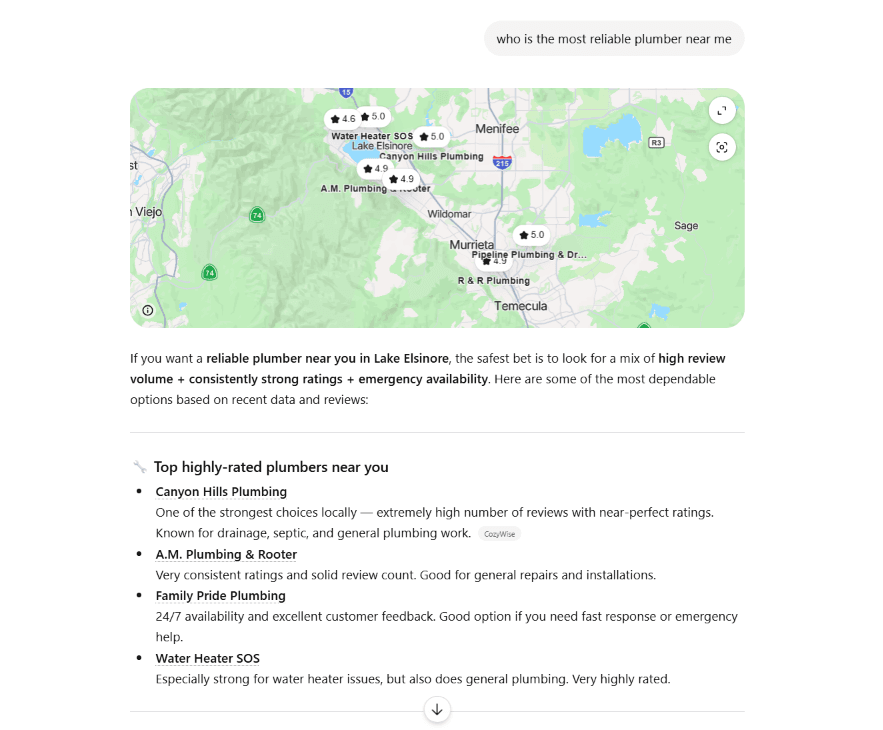
If your plumbing company relies solely on outdated keyword stuffing and buying generic backlinks, you are rapidly becoming invisible to the engines that now dictate consumer choice.
This guide reveals the exact engineering required to feed Large Language Models (LLMs) the Entity Trust Signals they need to crown your company as the #1 recommended plumber in your city. By utilizing the proprietary, field-tested strategies from the industry-leading Local SEO Playbook: Plumber Edition, we will show you exactly how to capture the AI First Mover Advantage.
The Death of the “10 Blue Links” (And the Rise of Answer Engines)
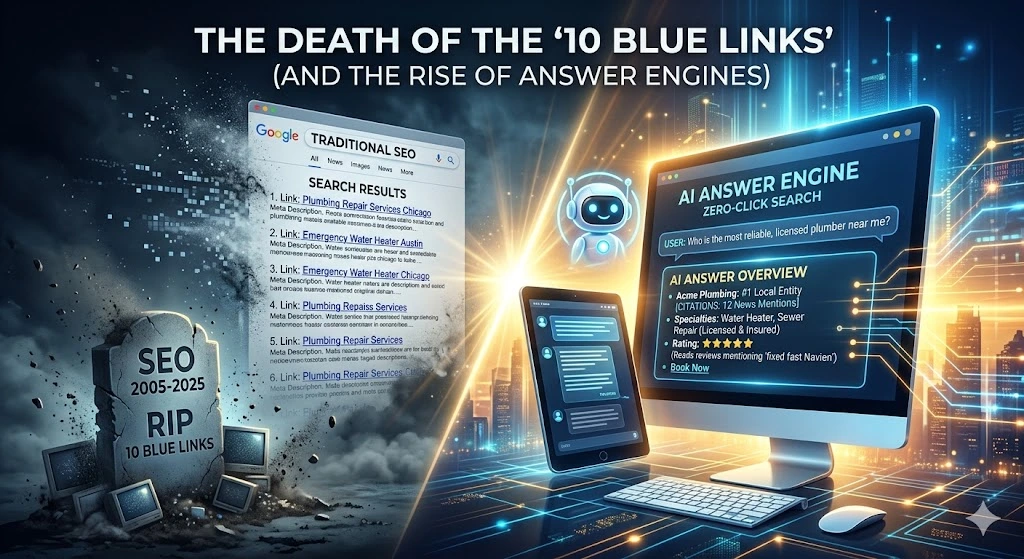
For the last two decades, plumbing marketing relied on a predictable funnel: a user searches “plumber near me,” clicks the top four websites, reads a few reviews, and makes a call.
In 2026, Search Engine Results Pages (SERPs) have transformed into Answer Engines.
When a user searches for an emergency water heater replacement in Chicago, Google’s AI Overviews intercept that query at the very top of the page. The AI synthesizes data from across the web, summarizes the average cost, lists the top three local companies based on aggregated review sentiment, and provides a direct answer. Traditional organic results are pushed so far down the page they are functionally dead.
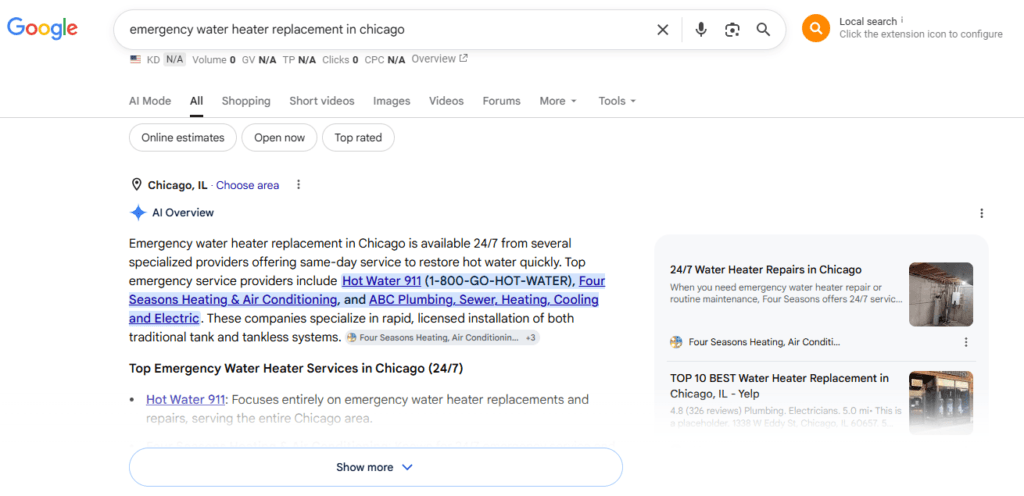
This creates the Zero-Click Reality. Users get their answers directly within the chat interface or the AI Overview without ever clicking on a traditional website link. Your goal as a high-revenue plumbing company is no longer just website traffic; it is Brand Mention Dominance. You must train the AI to inherently understand that your company is the most authoritative, trusted entity in your service area.
How LLMs Evaluate Plumbing Companies (The New Ranking Factors)
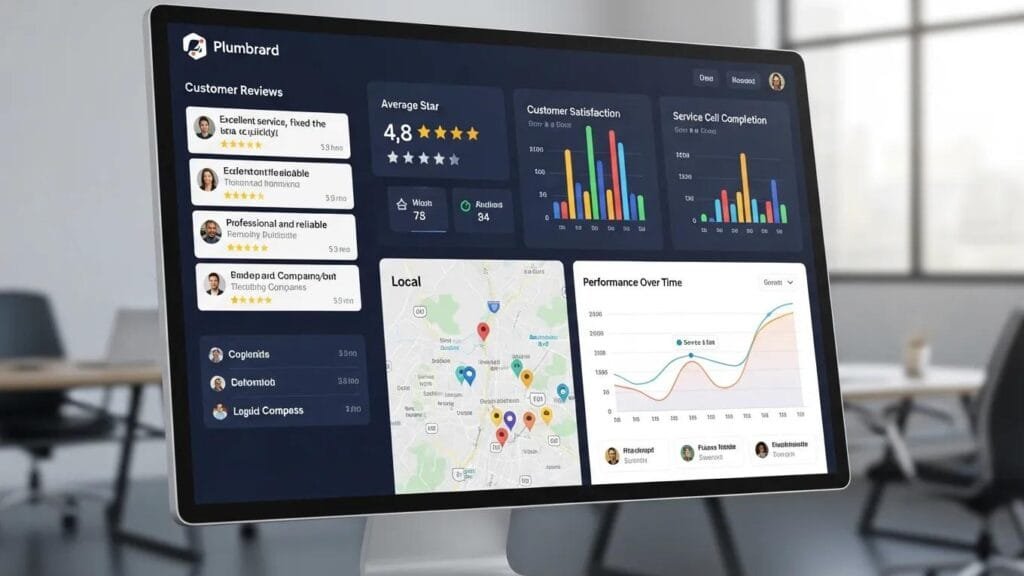
To rank in ChatGPT and Perplexity, you must stop thinking like a human reading a website and start thinking like an AI parsing a Knowledge Graph.
LLMs evaluate local businesses based on Entity Trust—a mathematical certainty that your business is exactly who it says it is, does exactly what it says it does, and is trusted by the local community. Here is how they calculate that trust in 2026.
Factor 1: Unstructured Entity Trust & RAG (Retrieval-Augmented Generation)
ChatGPT does not “know” who the best plumber in Austin is by default. It uses Retrieval-Augmented Generation (RAG) to scour the live web for unstructured data. It reads local news sites, Chamber of Commerce directories, and high-trust community forums like Reddit and Nextdoor.
If your brand name is consistently mentioned alongside phrases like “reliable,” “on-time,” “state-licensed,” and “upfront pricing” across these third-party platforms, the AI builds a high-confidence connection between your brand and those positive attributes.
Factor 2: Structured Data (Schema Markup)
If unstructured data is what people say about you, Structured Data is what you tell the AI directly. Advanced Schema Markup is the API that feeds data directly into the AI’s brain.
If your website lacks highly specific LocalBusiness and PlumbingService schema, the AI has to guess your operating hours, service area, and credentials. By perfectly formatting your state license numbers, exact GPS coordinates, emergency hours, and accepted payment methods in the code of your site, you remove all guesswork for the LLM.
Factor 3: Review Sentiment Analysis
AI doesn’t just count your 5-star reviews; it fundamentally reads and understands them. A generic review saying, “Great job, nice guys” carries almost zero weight in 2026.
LLMs extract entities from review text. A review stating, “They fixed my Navien tankless water heater fast and navigated the tight crawlspace without leaving a mess,” gives the AI proof that you handle specific brands, perform specific services, and deliver clean UX. When a user asks an LLM for a “tankless water heater expert,” the AI recommends you based on that extracted sentiment.
The 3-Step Blueprint to Optimize Your Plumbing Brand for AI
To dominate ChatGPT, Perplexity, and Google AIO, your agency must pivot from traditional SEO to AI Entity Engineering. Here is the exact blueprint pulled directly from the Local SEO Playbook: Plumber Edition.
Step 1: Dominate the “Information Gain” Gap with “Answer-First” Content
Stop writing generic “How to unclog a drain” blog posts. The LLMs have already ingested millions of these articles; adding another one provides zero “Information Gain” to the AI.
To stand out, you must write what the AI doesn’t already know. The Plumber Playbook mandates an “Answer-First” Content Strategy.
When targeting a local query like “Cost of trenchless sewer repair in Chicago,” your content must be engineered for machine readability:
- The First 2 Sentences: Answer the query immediately. “In 2026, the average cost of trenchless sewer line repair in Chicago ranges from $120 to $250 per foot, totaling $3,000 to $8,000 depending on the depth of the municipal tap.”
- The Evidence Block: Immediately follow the answer with cited authority. Cite the Chicago Department of Water Management codes, or provide proprietary pricing data from your last 50 jobs.
By providing highly specific, proprietary local data organized in an Answer-First format, you become the primary source data that LLMs cite in their outputs.
Step 2: Feed the Local Knowledge Graph (GBP Mastery)
Your Google Business Profile (GBP) is the nucleus of your local entity. Consistency is no longer just about ranking in Google Maps; it is how you train the LLMs.
The Local SEO Playbook: Plumber Edition dictates a rigorous GBP optimization workflow:
- The 7th-Grade Description: AI prefers clarity over jargon. Your GBP description must be 600-750 characters, written at a 7th-grade reading level. It must clearly state your years of experience, license status, and list your top 3 core services, ending with a direct Call to Action.
- Pre-emptive Q&A Seeding: You must seed your own GBP with at least 5 targeted Q&As that resolve high-friction AI queries (e.g., “Are your technicians background checked?”, “Do you handle local municipal permits for sewer replacements?”).
- The 3-Step Photo Optimization Protocol: You can no longer just upload photos from your iPhone. AI extracts EXIF data to verify physical locations.
- Rename raw files to
service-city-state.jpg(e.g.,water-heater-repair-dallas-tx.jpg). - Geo-tag the image with the exact GPS coordinates of the service area.
- Overlay your brand logo and city text onto 2-3 Hero shots to establish visual brand authority.
- Rename raw files to
- Google Sites Stacking: Utilizing a
sites.google.comproperty built around your brand passes massive, high-trust, Google-owned entity signals directly back to your local map listing. - Suspension Resilience: AI relies on active businesses. If your GBP gets suspended, your AI visibility tanks. Follow the Playbook’s strict suspension protocol by having your “Must-Have” documents (insurance certs, utility bills, branded storefront/truck photos) organized in a cloud folder, ready to deploy for instant reinstatement.
Step 3: Architect the “Trophy Content” & Digital PR Loop
You need high-authority, legacy institutions talking about your brand to establish E-E-A-T (Experience, Expertise, Authoritativeness, and Trustworthiness).
Instead of paying for low-quality guest posts, the Playbook utilizes Trophy Content combined with Digital PR. You create one massive, highly valuable local resource and pitch it to local media outlets, news stations, and home improvement blogs.
Proven PR Angles for Plumbers in 2026:
- Water Quality Studies: Publish a localized report on hard water impacts on appliances in specific neighborhoods, pitching it to local lifestyle bloggers.
- Winterization Warnings: Distribute a press release in late October detailing a “Winter Pipe Freeze Prevention Guide” specific to your city’s architecture (e.g., pier and beam homes vs. slabs).
- Local Code Changes: If your municipality updates its plumbing codes regarding water heater venting or sewer line compliance, be the first company to publish an easy-to-understand breakdown and pitch it to local news stations as an expert source.
The New Lead Funnel: Converting AI Recommendations into Calls
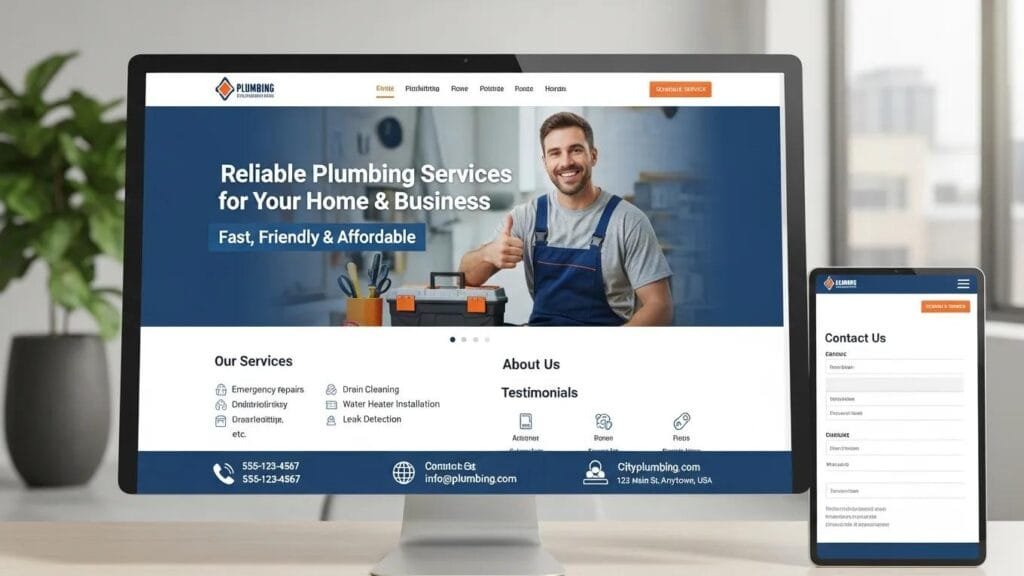
Getting recommended by ChatGPT or Perplexity is only step one. Step two is converting that high-intent user when they finally click your citation link.
UX for the AI Era requires absolute frictionlessness. When a user clicks through from an AI Overview, your landing page must instantly validate the AI’s recommendation.
If ChatGPT told them you were a “highly trusted, licensed professional,” but your website features broken links, stock photos of models holding wrenches, and no visible credentials, the user will bounce immediately.
Your AI-Era Landing Page Must Have:
- Visible Credentials: State license numbers, bonding info, and proof of insurance must be visible above the fold.
- Authentic Visuals: Real photos of your branded fleet and uniformed technicians wearing ID badges. Zero stock photos.
- Frictionless Booking: An integrated, seamless booking widget (like ServiceTitan, Housecall Pro, or Workiz) that allows the user to book an emergency slot in under 30 seconds without making a phone call.
The 2026 Plumbing Marketing Diagnostic (Are You Ready?)
Is your plumbing company ready for the AI search revolution, or are you operating on a 2015 playbook? Run this quick 5-point diagnostic on your brand today:
- The ChatGPT Test: Open ChatGPT and ask: “Who is the best plumber in [Your City]?” Are you listed? If not, who is, and what reasons did the AI give for recommending them?
- The Schema Audit: Do you have valid, highly specific
PlumbingServiceschema on your site, or are you relying on genericLocalBusinesstags? - The Photo Protocol: Are your project gallery images geo-tagged and following the 3-Step Optimization Protocol, or are they unoptimized files named
IMG_4920.jpg? - The Sentiment Check: Are your online reviews mentioning specific services, brands (e.g., Bradford White, Kohler), and neighborhoods, or are they generic?
- The Content Gap: Does your blog contain proprietary local data and “Answer-First” structures, or is it filled with generic SEO fluff that AI ignores?
Conclusion: The AI First Mover Advantage
The shift to AI Search is not coming; it is already here. The plumbing companies that adapt to LLM optimization, unstructured entity trust, and advanced schema markup today will build an insurmountable digital moat.
Because LLMs train on historical data and established trust, the companies that become the AI’s preferred recommendation in 2026 will be nearly impossible to unseat by competitors who wait until 2028 to adapt.
Don’t let your competitors own the AI Answer Engine. If you are ready to stop chasing algorithms and start dominating ChatGPT, Perplexity, and Google AIO, it’s time to upgrade your strategy.
If you want a custom AI Search Audit for your plumbing company using the proven Demand & Convert Local SEO Playbook, contact our team to schedule a Discovery Call today.
Frequently Asked Questions
Does traditional local SEO still matter for plumbers in 2026? Yes, but the mechanisms have changed. Traditional on-page SEO (meta tags, site speed, internal linking) is now considered the baseline “cost of entry.” However, traditional tactics like keyword stuffing and buying spammy backlinks no longer work. Instead, local SEO has evolved into Entity SEO—focusing on structured data, PR, and feeding accurate local information to the Knowledge Graph so AI can confidently recommend you.
How long does it take for ChatGPT or Perplexity to recognize my plumbing brand? Unlike Google, which can index a new webpage in 24 hours, LLMs like ChatGPT rely on periodic training cutoffs and live RAG (Retrieval-Augmented Generation) integrations. If you implement aggressive Digital PR, update your schema, and get featured in high-trust local directories, RAG-enabled AI models (like Perplexity and ChatGPT Plus) can begin recommending your brand within 30 to 60 days. Deep, foundational inclusion in core AI training sets takes longer.
Why is an AI search engine recommending a plumbing competitor with worse reviews than my company? AI does not sort simply by review quantity or average star rating. LLMs evaluate “Entity Trust.” Your competitor may have a lower star rating, but they likely have superior structured data (Schema), deeper penetration in local news media (PR), or specific mentions of niche plumbing services (like hydro-jetting or commercial boiler repair) across forums that the AI deemed highly relevant to the specific prompt being asked.
Subject Matter Context
Core Pillar Connection: This technical guide is part of our Guts To Glory Field Proof Systems series. For comprehensive execution and guaranteed results in your local area, review our official protocol: Hyper-Local paid Social and Meta retargeting Moats .
Related Guts To Glory Field Proof Systems Resources:
- • How Smart Contractors Use Proximity Loops to Print Money
- • What Is a Social Media Marketing Service? (2026 Guide for Blue-Collar Contractors)
- • How to Market Your Small Trade Business on Social Media — and Actually Get Results
- • The Best Brands On Social Media In 2026
- • Hashtag Research: The Complete Guide to Hashtags for Local Contractors

 SEO Like a Pro With These Link Building Tips & Techniques