Local
SEO
Play
book
Why Your Phone
Isn’t Ringing
The most valuable real estate in your market isn’t a billboard on the freeway. It’s the top three results in Google Maps.
When a homeowner’s water heater fails on a Sunday morning, they don’t flip through a phonebook. They search “emergency plumber near me” on Google. In the next 8 seconds, they call one of the three businesses in the local map. If you’re not there, that job — and hundreds like it — go to a competitor every single time.
The good news: most plumbing companies have never systematically optimized their Google presence. That means significant opportunity for those who do. This guide gives you the exact playbook.
What this guide gives you
- A fully optimized Google Business Profile that Google trusts and customers click
- Website content and landing pages built for searches that book jobs
- A citation and backlink foundation that signals authority to Google
- A review and brand sentiment strategy that gets you recommended by AI answer engines
- Copy-paste AI prompts — no SEO experience required
How to use this guide: Work through the three sections in order. Look for Quick Win tags — those are actions completable in under 30 minutes with immediate impact. Replace everything in pink brackets with your real business information before using a prompt.
What’s Inside
Four sections. One goal: more calls from Google — and recommendations from AI.
Also includes: Your Gap Assessment — a checklist to identify your biggest ranking gaps, a 90-Day Roadmap, and next steps.
Business
Profile
Before a customer ever visits your website, they’ve already judged you by your Google Business Profile. This section shows you how to optimize every element so Google shows you first — and customers choose you.
Essential GBP Elements
Your Google Business Profile — the free listing that appears in Google Maps and local search results — has fields most plumbers have never fully completed. These are non-negotiable.
- Business name — Use your exact operating name. Don’t add keywords or your city — Google penalizes this.
- Phone number — Use the same local number on your website and every online directory. (This consistency across listings is called NAP — Name, Address, Phone.)
- Address — Must match your website and all directories exactly. Even “St” vs “Street” creates mismatches.
- Primary category — Set to “Plumber.” Add secondary: Emergency Plumber, Drainage Service, Water Heater Installation Service.
- Services list — Add every service: Drain Cleaning, Water Heater Repair & Installation, Pipe Repair, Sewer Line, Leak Detection. Each is a keyword signal.
- Description — See page 02 for the exact AI prompt. Takes 10 minutes.
- Photos — At least 10 to start. Before/after jobs, team in uniform, branded service vehicle. See page 03.
- Website link — Link to your main site. This passes authority signals in both directions.
- Reviews — Ask every satisfied customer. Respond to every review — positive and negative. Volume and recency both affect your ranking.
Keep your profile active — every week
- Post a Google Business update (prompt on page 04)
- Respond to new reviews within 48 hours
- Update hours or service area whenever anything changes
Your GBP Description
A well-written description tells Google which searches you’re relevant for and gives homeowners a reason to choose you over the next result.
It helps customers find you
Keywords in your description tell Google which searches you’re relevant for — more relevant searches means more calls.
It builds trust before a call
A professional description signals credibility. Homeowners are inviting you into their home — they’re reading this before they dial.
Open ChatGPT, Gemini, or Claude. Paste this. Replace everything in pink.
The description should be 600–750 characters, written at a 7th-grade reading level. It should feel trustworthy and approachable — not like a sales pitch.
Focus on our location in [City, State] and naturally include: emergency plumber, drain cleaning, water heater installation, plumber near me.
Highlight that we are [licensed & insured / family-owned / X years of experience] and offer 24/7 emergency service to homeowners in the [City] area.
Google now shows AI-generated summaries for many local searches. Businesses with keyword-rich, complete profiles are more likely to be cited in them. Your description is the first place to start.
Not sure how to fill in the blanks? We write GBP descriptions for plumbing clients every week.
Optimizing Google Photos
Plumbers with 20+ optimized photos get more profile views and more clicks than those with a handful of unoptimized images. Photos signal an active, legitimate business to Google and to customers.
Rename every file before uploading
Rename photos to describe the content: water-heater-installation-phoenix-az.jpg — this tells Google exactly what the image shows and where you work.
Geo-tag your photos
Use a free tool to embed GPS coordinates into the image before uploading. This reinforces your service area to Google’s local algorithm.
Add a keyword overlay to select photos
On 2–3 before/after shots, use Canva to add your business name, service, and city in the corner. Don’t do this on every photo — it looks unnatural and may be flagged.
Photo checklist for plumbers
- Before & after: drain jobs, pipe repairs, water heater installs
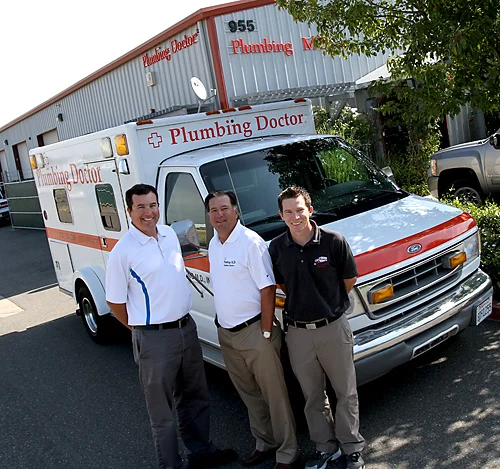
- Team in uniform next to branded service vehicle
- Finished work: clean connections, new fixtures, organized spaces
- Exterior of office or shop with visible signage
Do this today
Pull 5 recent job photos from your phone. Rename them with service + city. Upload to your GBP now. 15 minutes. One of the highest-impact actions in this entire guide.
Google Business Posts
Regular posts signal to Google that your business is active. Inactive profiles rank lower. One post per week — use the prompt below to make it a 3-minute task.
End every post with your business name and address
Reinforces that your name, address, and phone (NAP) are consistent — a local ranking signal.
Link to relevant pages on your site
Link to your homepage, a service page, or your GBP profile. Multiple links per post are allowed.
Never put your phone number in the post body
Google will remove the post. Use the call button in the GBP interface instead.
Don’t keyword-stuff your business name
Your display name must match your legal name. Adding “Emergency Plumber Dallas” violates Google’s Terms of Service.
Paste into ChatGPT, Gemini, or Claude. Replace the pink text.
Topic: [e.g., summer drain maintenance tips / water heater special / recent job / we’re hiring]
Include naturally: [plumber near me, drain cleaning in (City)]
CTA: [visit our website / book online / call us]
1,000–1,300 characters. 10th-grade reading level. Do not include a phone number in the body.
Questions & Answers
You can add questions to your own profile — and answer them. This is one of the most overlooked ranking tools available. Build toward 50–100 total over time.
Plumbing Q&As to add right now
- How much does it cost to fix a leaky faucet in [City]?
- How long does water heater installation take?
- Do I need a permit to replace a water heater in [City, State]?
- What causes low water pressure in a home?
- What’s the difference between drain cleaning and hydro jetting?
Replace the pink text, then paste into your preferred AI tool.
Write 5 Questions and Answers focused on: [drain cleaning / water heater installation / emergency plumbing — pick one].
Each answer: 150–250 words, conversational, 7th-grade reading level, active voice. Include the company name and city in at least 2 answers. Use relevant long-tail keywords naturally throughout.
Your Website &
Local Rankings
Your website and your Google Business Profile work as a system. A strong website improves your local rankings. Here’s what actually moves the needle.
🖼️ Name your images properly
Rename every image before uploading: drain-cleaning-phoenix-az.jpg. Add matching alt text. Google reads both to understand your pages.
📞 Make it easy to call you
Click-to-call phone number and a contact form on every page. Google tracks whether visitors engage — calls and form fills are the strongest signals.
Website checklist for local rankings
- Business name, address, and phone in the footer of every page — matching your GBP exactly
- Page speed under 3 seconds on mobile (test free at pagespeed.web.dev)
- A separate page for each major service — not everything on one page
- Your city + service keyword in the main heading (H1) on each service page
- A Google Map embed on your contact page
- HTTPS enabled — the padlock symbol in the browser bar
Set up Google Analytics to track phone calls, form submissions, and direction requests. Track your Google Maps ranking for 3–5 key searches weekly — e.g., “plumber [city],” “drain cleaning [city].” Rankings move first. Calls follow within 30–60 days.
Google Sites
for Plumbers
Google lets any business create a free website at sites.google.com. For plumbers, this is a low-effort win — a Google-owned property that can rank independently and sends trust signals directly to your main site.
Why it works
- Google trusts and indexes its own properties quickly
- Free backlink from a Google domain to your main site
- Can rank independently for local keyword searches
- Takes about an hour to set up — no web design needed
Setup steps
- Go to
sites.google.com, choose a template - Name it: [City] Plumber | [Company Name]
- Match your main website’s branding
- Embed your Google Business Profile code
- Add geo-tagged, keyword-named images
- Add your GBP description (prompt from page 02)
- Link prominently to your main website
- Add interior pages for top 3 services
Also: optimize your built-in GBP website
Your GBP includes a mini-website. Use this prompt to write optimized body content for it:
If Your Profile
Gets Suspended
Google suspends profiles that appear to violate its policies — sometimes incorrectly. Use this template and checklist to request reinstatement.
I am writing to request reinstatement of my Google Business Profile for [Your Company Name] at [Full Address]. I understand my profile was suspended and sincerely apologize for any inconvenience.
I have attached all required documentation to verify the legitimacy of my business. I am a licensed, insured plumbing contractor. My GBP is essential to how local homeowners find and contact me for plumbing services. I am fully committed to Google’s guidelines.
Sincerely, [Your Name, Owner]
What to attach
Rename every file clearly before attaching — e.g., plumbing-license-[company].pdf. In the video walkthrough, narrate each document as you show it.
That
Ranks
Your website needs to answer the questions homeowners are typing into Google — and do it better than the competitor ranking above you. This section gives you the keyword strategy, landing page blueprint, and AI prompts to make that happen without hiring a full-time writer.
Keyword Research
for Plumbers
Keywords are the searches homeowners type when they need a plumber. Knowing which ones have volume — and which ones your competitors rank for — tells you exactly what to build your site around.
Core “job-booking” keywords to start with
Use Gemini, ChatGPT, or Claude. Replace pink text.
1. Top 10 Keywords — Most relevant and valuable for a plumbing company in this market. Rank from most to least relevant.
2. Difficulty Score — How competitive each keyword is, from 0 (easy) to 100 (very hard).
3. Table format — Keyword | Relevance (1–10) | Difficulty (0–100)
4. 10 Long-Tail Keywords — More specific phrases that are easier to rank for. Display as a simple list.
Finding Long-Tail
Opportunities
Long-tail keywords are longer, specific searches — like “how much does it cost to replace a water heater in Phoenix.” Less competitive. Often come from people ready to book, not just browsing.
Paste into your preferred AI tool. Replace all pink text.
Consider:
• Search intent: Prioritize keywords where someone is ready to hire, not just researching
• Local relevance: Include city, neighborhood, and metro-area variations
• Target audience: Homeowners, landlords, and property managers
• Seasonal patterns: Flag keywords that spike in winter or summer
Return 15 keywords as a table: Keyword | Intent (hire/research) | Notes
Long-tail examples for plumbers
- how much does water heater replacement cost in [city]
- emergency plumber [city] available tonight
- who to call for burst pipe in [city]
- drain cleaning vs hydro jetting [city]
- do I need a permit for water heater replacement in [city]
FAQs That Rank
and Convert
Good plumbing FAQs address cost, timeline, and process — the three things homeowners always want to know before they call. They also rank in Google’s “People Also Ask” results.
Use for FAQ sections on your service pages.
Each answer: 150–250 words, conversational, 7th-grade reading level, active voice. Include the company name and city in at least 2 answers. Use relevant keywords and long-tail phrases naturally.
Use for adding Q&As directly to your Google Business Profile.
Each answer: 150–250 words, conversational, 7th-grade reading level. Write as if answering a homeowner who wants to understand their options before calling a plumber.
Local Service
Landing Pages
One page for every city and every service. A plumber serving 5 cities with 5 core services should have 25 landing pages. Each page targets a specific job-booking search.
- Page URL contains city + service keyword (e.g.,
/plumber-phoenix-az) - H1 heading: city + service keyword
- H2 heading: supporting keyword (e.g., “Affordable Drain Cleaning in [City]”)
- Click-to-call phone number visible above the fold
- Clear call-to-action in every major page section
- Reviews section with real customer names and their city
- “Why Choose Us” block: licensed, insured, years of experience, guarantee
- Google Map embed + business hours visible
- Total word count: 1,000–2,500 words
- 5–6 plumbing FAQs answering local questions
- 300–500 word “About Serving [City]” section
- Internal links to related service pages
- 10–15 photos renamed:
[brand]-[service]-[city]-[descriptor].jpg - Every image has descriptive alt text
- Real job photos — not stock images
Need these pages built and live? We build local landing pages for plumbing companies in about 2 weeks.
On-Page Copy
& Metadata
Two prompts: one to write or improve the content on any page of your site, one to write the title and description that appear in Google search results.
Use for any service page, homepage, or about page.
Written for: [homeowners in (City, State) who need plumbing services]. Include naturally: [emergency plumber (City), drain cleaning, water heater installation, licensed plumber near me].
Reference competitor at [Competitor URL] — our content must be more useful and informative.
Tone: professional and trustworthy. Goal: get visitors to call or fill out a form. ~500 words, 10th-grade level. Location: [City, State].
The title and description are what show up when someone Googles you.
Business: [Company Name] | City: [City, State] | Service: [Emergency Plumber / Drain Cleaning / Water Heater]
Title examples: “[Company] | Emergency Plumber [City] | Available 24/7”
Meta description examples: “[Company] is [City]’s trusted emergency plumber. Licensed, insured, available 24/7. Call for same-day service.”
Location Support
Articles
A network of 10–20 articles about your service area — not about plumbing — tells Google that your site is a genuine local authority. Think of it as giving Google proof that you actually know the cities you serve.
How they work
Articles link to your service pages and local authoritative sources — connecting your business to the geography.
What to write about
Topics about the city — not your services. City content builds location relevance; service pages do the selling.
AI-generated
All articles can be AI-generated. Aim for 800–1,200 words each. Quality over quantity — 10 good ones beats 20 thin ones.
Keep them accessible
Add to your sitemap and footer. Don’t put them in your main navigation.
Approved topics — plumbing edition
Your
Authority
Citations are the backbone of local SEO for service businesses. They’re mentions of your name, address, and phone number across directories and review sites. Google uses them to verify your business is real, established, and trustworthy. This section shows you where to get them and how to make each one count.
Finding the Right
Citations
A citation is any online mention of your business name, address, and phone number (NAP). The more consistent and widespread your citations, the more Google trusts your business is legitimate and established in your market.
Check where your top competitors are listed
Look up top-ranking plumbers in your market. See which directories link to them — those are your highest-priority targets.
Search Google for your own business
Search “[Your Company Name] + [phone number]”. This shows existing citations and reveals directories you haven’t claimed yet.
Join your local Chamber of Commerce
Chamber directory listings are one of the highest-value citations available — geographically hyper-relevant to your market.
Use automation for volume
Tools like BrightLocal can submit your business info to 100+ directories automatically. Useful once your core info is finalized and consistent.
Priority directories for plumbing companies
Writing Citations
That Convert
10 fully built-out listings beat 100 empty ones every time. Here’s how to make each citation do maximum work.
The #1 rule: exact consistency
Your business name, address, and phone must be identical everywhere online — same abbreviations, same format. Even “St.” vs “Street” is a mismatch to Google’s algorithm.
Write this once, reuse it across all your directory listings.
Include: an overview of the business, the main plumbing services offered (drain cleaning, water heater, emergency repair, etc.), cities and areas served, and why customers choose this company. Include links to relevant service sections of the website where mentioned.
Complete every field — not just the basics
- Add 5–10 photos (use the same optimized photos from your GBP)
- List your full service menu — not just “Plumber”
- Add hours, payment methods, and service area details
- Choose the most specific categories each platform allows
Citation management is the most time-consuming part of local SEO. We handle the entire citation build for plumbing clients.
Backlinks &
Advanced Tactics
Backlinks are links from other websites to yours — one of the strongest signals Google uses to rank local businesses. Two types matter most for plumbers.
Service Page Links
Build links pointing to your core service pages: /emergency-plumber-[city], /drain-cleaning-[city]. Sources: local press releases, industry associations, home improvement blogs, and local directories.
GBP Profile Links
Build links directly to your Google Business Profile URL. This reinforces your Google Maps ranking signals and tells Google your profile is authoritative in its geographic area.
ChatGPT, Perplexity, and Google Gemini now recommend local plumbers for conversational searches like “best plumber in [city]” or “who should I call for a burst pipe?” To appear in these results: maintain consistent brand mentions across authoritative sites, keep GBP data complete, and generate genuine 5-star reviews at volume. Fast-growing channel for service businesses in 2026.
Getting mentioned in local news sites and community platforms earns powerful local backlinks. Pitch yourself as an expert source on water quality, winter pipe freeze warnings, or local plumbing code changes. One strong local press mention can outperform dozens of directory links.
Recommendation
In 2026, ChatGPT, Perplexity, and Gemini actively answer “best plumber in [city]” questions. Whether they recommend your business depends entirely on what they find about you across the web. This section shows you what to build and why reputation is now a ranking signal.
AI Answer Engine
Visibility
When a homeowner asks ChatGPT “best plumber in Phoenix” or Perplexity “who should I call for a burst pipe tonight?”, they’re not getting a list of links. They’re getting a recommendation. Here’s how to be the business recommended.
AI answer engines index the same signals Google does — your GBP data, review site profiles, directory listings, and website content. They weigh review volume and sentiment heavily, and they pull short, direct answers from FAQ pages. Strong presence across these sources = higher recommendation likelihood.
Tactic 1: Answer-first structure
Lead every FAQ with a direct 1–2 sentence answer before any explanation. AI tools pull these verbatim as snippets. “The cost to replace a water heater in Phoenix ranges from $900–$1,500 depending on tank size and labor.”
Tactic 2: Question-format pages
Publish dedicated pages targeting “how do I…”, “why does my…”, “when should I replace…” questions. These are the exact informational queries AI tools are asked to answer — and where they’ll cite you.
High-value question topics for plumbers
Use for FAQ sections and dedicated question pages. Replace pink text.
Write a FAQ page targeting the question: [e.g., “How much does water heater replacement cost in (City)?”]
Structure: Start with a direct 2-sentence answer. Then expand with: cost breakdown, factors that affect price, what’s included, and a clear CTA. 400–600 words. 8th-grade reading level. Include city name naturally 3–4 times. Write for a homeowner who is comparison shopping right now.
Brand Sentiment &
Recommendation Likelihood
Reviews, directory listings, and third-party mentions aren’t just a ranking signal for Google — they’re the primary data AI tools use to decide whether your business gets recommended at all. Positive sentiment at scale is now a growth strategy.
The three trust signals AI weighs
- Review volume & recency — 50+ reviews, with new ones monthly, signals an active, legitimate business
- Platform diversity — Google, Yelp, Angi, HomeAdvisor, Houzz. Mentions across many authoritative sites = stronger signal
- Third-party mentions — Local news, PHCC association, chamber of commerce, homeowner forums. One genuine press mention can outweigh dozens of directory entries
Getting reviews consistently
- Text customers a review link within 2 hours of job completion — response rate drops steeply after 24 hours
- Add a QR code to your invoice that links directly to your Google review page
- Ask by name: “Hi [Name], we’d love a quick review” converts better than a generic blast
- Never incentivize reviews — platform terms and Google guidelines both prohibit it
Review response strategy
Respond to every review within 48 hours. For positive reviews: thank by name, mention the specific service. For negative reviews: acknowledge publicly, take it offline (“please call us at [number]”), never argue. AI tools read your response pattern — businesses that engage are rated as more trustworthy than those that don’t respond.
ChatGPT, Perplexity, and Gemini now incorporate structured sentiment analysis when recommending local businesses. A consistent pattern of 5-star reviews mentioning specific services (“great drain cleaning,” “water heater installed same day”) directly improves your likelihood of appearing in AI-generated answers for those service queries. Treat every review response as content for an AI training set.
We run full review acquisition and reputation management programs for plumbing clients — including response templates and automated follow-up workflows.
Your Gap Assessment
Check off everything you’ve already done. Every unchecked box is a ranking opportunity your competitors may already be using.
- All GBP fields complete: name, address, phone, categories, services, website
- Description written with target keywords (600–750 characters)
- 20+ photos uploaded with keyword-based filenames
- Posting at least once per week
- 10+ Q&As added to the profile
- Responding to every review within 48 hours
- Google Site created and linked to main website
- Separate service page for each major offering
- City + service keyword in the H1 on every service page
- 3+ local city/service landing pages built
- FAQs on every service page
- Page titles and meta descriptions written for every page
- 5+ location support articles published
- Listed on 10+ major directories with complete profiles
- Full business description on every major listing
- NAP identical across every online listing
- 5+ backlinks pointing to service pages
- Listed in local Chamber of Commerce directory
- 25+ Google reviews with a 4.5-star average or higher
- Responding to every review within 48 hours
- FAQ content on website using direct answer-first format
- Business listed on Yelp, Angi, and HomeAdvisor with complete profiles
- At least one third-party mention (press, association, community platform)
Score yourself: 0–6 checked = largely invisible · 7–14 = building momentum · 15–21 = you’re competitive · 22–27 = you’re ahead of most plumbers in your market — and likely appearing in AI recommendations. The unchecked boxes are your roadmap.
Your 90-Day
Roadmap
Trying to do everything at once leads to nothing getting done. Here’s a sequenced, month-by-month plan that builds momentum and delivers results in the right order.
Most plumbing companies that implement this playbook consistently see measurable Google Maps visibility improvement within 60–90 days. Rankings move first — calls follow. Start with the Quick Wins and build from there.
Your next 10 jobs are already
searching for you on Google.
The question is whether they find you — or find the plumber down the street who got there first.
We’ll review your Google Business Profile, your website, your competitors, and your local rankings — then show you exactly which gaps are costing you the most calls. Most profiles we audit are missing at least 3–4 of the items in this guide. We’ll find yours.
- ✓ See exactly where you rank for “emergency plumber [your city]” and 4 other searches that book jobs
- ✓ Find out which competitors are outranking you — and why
- ✓ Walk away with a prioritized list of the 3 things that will move your ranking fastest
- ✓ No commitment. No pressure. Just clarity on where you stand and what to do next.
We implement the full playbook for your plumbing business while you focus on running jobs.
GBP optimization, landing pages, citations, and rank tracking — all live within 30 days.
White-label: update --brand-primary, --brand-name, and --brand-url at the top of this file.