16 Best Plumbing Website Designs of 2026: The Core Vitals & Local AI SEO Audit
Most design agencies build plumbing websites that prioritize artistic vanity over direct-response revenue. They create heavy, complex sites that look like art gallery portfolios but fail at the single most important task: turning cold, panicked local search traffic into immediate phone calls and high-ticket diagnostics. If your plumber website design isn’t built around conversion, you are handing jobs to your competition before the phone ever rings.
When a property manager realizes their 1950s cast-iron plumbing is failing, or a homeowner finds their basement flooding at 2:00 AM, they do not care about a generic “About Us” page. They want absolute authority, and they want it fast. If your site relies on generic corporate copy or takes 6 seconds to load, that $15,000 trenchless sewer repair goes to the massive Private Equity-backed franchise down the street.
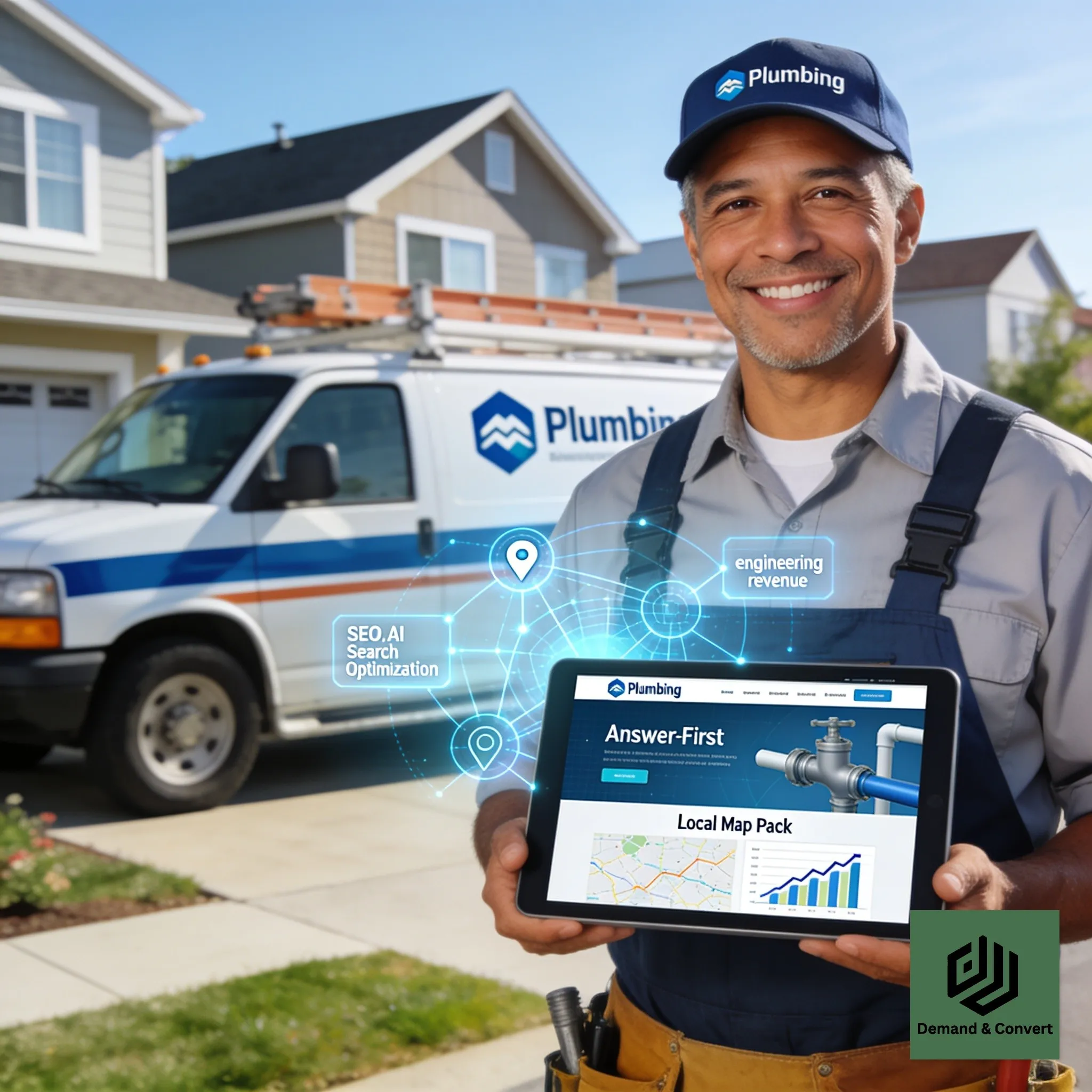
The best plumbing websites of 2026 act as structural conversion engines and plumbing lead generation websites — pulling in high-intent local traffic and routing it directly to your dispatch board. Here is our clinical breakdown of the core vitals that actually move the needle, followed by an architectural audit of the top plumbing website designs in the industry.
Factors That Engineer a High-Converting Plumbing Website in 2026
Forget the bloated 47-point checklists sold by generic marketing agencies. To dominate your local territory, win on local SEO for plumbers, and stop renting shared leads from brokers like Angi, your site must execute on these clinical pillars of plumbing website conversion.
The 2.5-Second Dispatch Speed (Mobile Core Web Vitals)
From the moment a visitor taps your link in the Google Map Pack, the clock starts. Getting core web vitals right for your plumbing site is non-negotiable: if your Largest Contentful Paint (LCP) takes longer than 2.5 seconds, panicked homeowners on 5G cell connections will bounce. You must compress heavy images, defer non-critical JavaScript, and utilize structural HTML to ensure your site is lightning-fast. A slow site actively starves your dispatch board. To understand the math behind this, review our analysis on The 2.5-Second Death Window.
Frictionless Direct-Response Routing
Interactive elements are useless if they don’t capture intent. Your primary calls-to-action (CTAs) cannot be hidden in nested menus. Your site must feature sticky, thumb-friendly tap-to-call buttons and highly structured intake forms that qualify the lead (e.g., “Emergency Leak,” “Water Heater Replacement,” “Sewer Diagnostic”) before the dispatcher even picks up the headset.
Semantic Hubs & Entity Authority
You cannot win high-ticket jobs with one generic “Services” page. Google’s AI needs to understand exactly what your entity is. Your website must be built on isolated, transactional service silos (e.g., /trenchless-sewer-repair-[city]). We do not write fluff; we build AEO-optimized Knowledge Hubs that answer complex diagnostic troubleshooting queries, forcing Google’s Vector Search to recognize you as the definitive local authority. For more on this protocol, read our guide on The Death of Keyword Stuffing.
Weaponized Field Proof (Documercials & Geo-Data)
Stock photos of actors holding pristine wrenches destroy consumer trust. Elite plumbing sites rely on raw, authentic field photos of uniformed crews and branded trucks. Furthermore, these images must be injected with strict EXIF GPS coordinates and descriptive alt text before uploading, sending massive geo-spatial proximity signals back to the retrieval engines.
API-Fed Review Sentiment
Static, typed-out testimonials are ignored by modern buyers. Your website must integrate live, API-fed review widgets that pull in 5-star data from your Google Business Profile. This proves real-time velocity and feeds positive brand sentiment directly into AI answer engines like ChatGPT and Gemini.
Architectural Audits of 2026’s Top Plumbing Websites
We evaluated the top plumbing sites on the web. Here is the technical breakdown of where they succeed in capturing high-ticket search intent, and the structural leaks costing them revenue.
Mr. Rooter Plumbing
As a massive franchise, Mr. Rooter Plumbing relies on scale and heavy branding.
- The Conversion Highlights: Their site hierarchy is a masterclass in structural steel. They cleanly isolate their service silos into residential, commercial, and emergency dispatch routing. The emergency pipeline bypasses educational content and forces the user directly to a high-priority intake system.
- The Performance Gap: The site relies heavily on bloated corporate templates. For independent contractors looking to beat franchises like this, the key is hyper-local entity building. Mr. Rooter lacks the raw, authentic field proof (Documercials) required to build deep trust in specific, granular zip codes.
Aqua Plus Plumbing
Aqua Plus Plumbing strips away the noise and focuses strictly on generating the lead.
- The Conversion Highlights: Extreme direct-response focus. They do not overload the user with 5,000 words of technical history on the homepage. They present the diagnostic services and instantly prompt the user to “Request More Information,” pushing them straight into the sales pipeline.
- The Performance Gap: While minimal design is fast, a lack of deep, semantic content is a structural failure for organic ranking. To capture exact-match long-tail queries (e.g., “cast iron pipe replacement cost”), they need to deploy deeper diagnostic service pages utilizing strict H2 to H3 heading nesting.
Rooter Man
Rooter Man covers all of Los Angeles County using a highly condensed, single-page architecture framework.
- The Conversion Highlights: Every single diagnostic service listed is paired with an aggressive “Book Online” call-to-action. The CTA density is incredibly high, ensuring that no matter how far the anxious property manager scrolls, the solution is always one tap away.
- The Performance Gap: Single-page sites are a liability for high-ticket local SEO. You cannot build adequate topical authority for both “hydrojetting” and “tankless water heaters” on the same URL. They are bleeding LSI keyword opportunities by not building isolated geographic nodes for each core service.
Advanced Plumbing and Rooter Service
Operating out of Texas, this firm leans heavily into establishing local proximity and trust.
- The Conversion Highlights: They weaponize their visual assets. By utilizing popular Texas imagery and localized video right on the homepage, they instantly separate themselves from sterile, faceless national lead brokers.
- The Performance Gap: Auto-playing background video is a massive risk to Core Web Vitals. If this video is not properly deferred and compressed, it will shatter the 2.5-second load window on mobile networks, causing panicked homeowners to bounce back to the Google Map Pack.
Rooter Hero
Rooter Hero is built around interactivity and reducing the friction of booking a truck roll.
- The Conversion Highlights: Their multi-step online scheduling form is one of the best in the industry. By breaking the intake process into four micro-steps, they reduce cognitive load for the user while capturing vital diagnostic data for the dispatch team. They also embed real video testimonials, creating a bulletproof trust stack.
- The Performance Gap: High interactivity often requires heavy client-side JavaScript. To ensure they don’t lose search visibility, they must ensure these interactive booking apps are loaded asynchronously so they do not block the primary rendering of the page’s HTML text.
Ritz Plumbing
Ritz Plumbing takes a clinical, minimalist approach to capturing Los Angeles emergency traffic.
- The Conversion Highlights: Absolute CTA consistency. The “Book a Ritz Plumber” button is anchored and repeated strategically. They understand that in an emergency, the user doesn’t want to read; they want to dispatch a technician.
- The Performance Gap: To fully lock down their local radius against PE-backed giants, Ritz needs to ensure their off-page citations and NAP (Name, Address, Phone) data perfectly matches the structured schema markup on their site, solidifying their local entity status.
Stop Renting Your Pipeline. Build the Machine.
If you are a hungry, mid-sized plumbing operator, your website cannot just be a digital brochure. It must be the structural steel of your entire revenue system. When you execute on clinical Core Web Vitals, semantic content, and frictionless dispatch routing, you no longer have to buy shared leads from predatory brokers. You own the market.
Are you ready to stop fighting for scraps and build the structural steel your business deserves? Review our 118-Point Execution Blueprint and book a strategy call today.
Subject Matter Context
Core Pillar Connection: This technical guide is part of our High Performance Contractor Web Architecture series. For comprehensive execution and guaranteed results in your local area, review our official protocol: High-Performance Mobile-dominant Contractor Conversion Engines .

 16 Best Remodeling Website Designs of 2026: The Core Vitals & Local AI SEO Audit