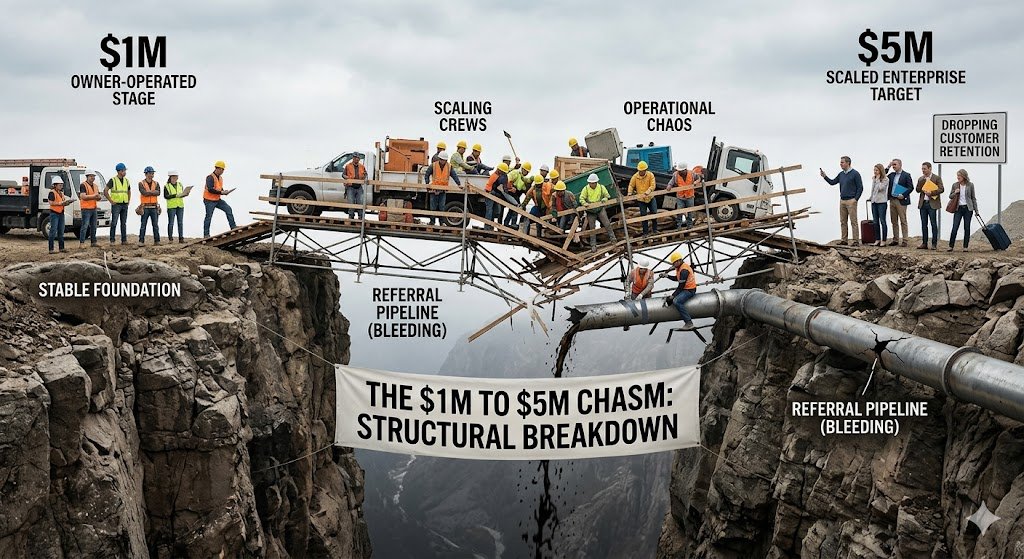
When you first started your contracting business, customer retention was easy. You were the estimator, the lead technician, and the dispatcher.
You remembered every homeowner’s name. You knew which client had a dog that needed to be kept in the house, and you personally shook their hand when the job was done. Because you were heavily involved in every $5,000 to $15,000 install, your customers trusted you. When their neighbor’s roof leaked or their sister needed an HVAC swap, they referred you without hesitation.
But then you did what you set out to do: you grew. You crossed the $1 million revenue mark and started gunning for $3 million, then $5 million.
You added trucks to the fleet. You hired a front-office dispatcher. You stepped out of the field to focus on operations.
And almost immediately, things started slipping through the cracks.
A past customer calls for follow-up work, but your overwhelmed dispatcher puts them on hold for ten minutes while dealing with unqualified tire-kickers. An estimator promises to email a quote for a Phase 2 project, but forgets. The personal touch vanishes, communication becomes sloppy, and suddenly, that loyal customer who bought a $15,000 system from you two years ago just hired a private-equity-backed regional franchise to do their $20,000 upgrade.
If you are a mid-sized, hungry contractor, you cannot afford to leak past customers and referrals. Here is the clinical truth about why your operational growth is breaking your customer retention, and the exact mathematical blueprint to fix it using automated revenue engineering.
The Dispatcher’s Nightmare: When “Work Faster” Is Not a Strategy
As your trade practice expands, the sheer volume of communication multiplies exponentially.
Most owners try to solve this by simply asking their front desk to “handle it.” But relying on manual follow-ups, messy Excel spreadsheets, and disjointed email accounts is a recipe for disaster.
Here is where the pipeline breaks down:
- The Shared Lead Distraction: Because you are trying to feed multiple crews, you panic and buy shared leads from brokers like Angi or HomeAdvisor. Your dispatcher is now spending 30 hours a week aggressively dialing these cold, shared leads, arguing over price with people who submitted their info to five different plumbers simultaneously.
- The Referral Neglect: While your office is busy fighting for table scraps from lead brokers, your warm pipeline—past customers calling back for more work, or calling to refer a friend—is sent to voicemail.
- The “Ghosted” Trust Asset: Homeowners do not expect you to be perfectly on time every day, but they do expect communication. When a growing shop fails to send automated appointment reminders, follow-up emails, or post-job review requests, the homeowner feels treated like a commodity. The trust you built is gone.
You are spending thousands of dollars to rent new leads while completely abandoning the most profitable asset your business owns: your existing customer base.
The Mathematical Reality of the “Leaky Bucket”
Stop looking at marketing as just “getting the phone to ring today” and start looking at Customer Acquisition Cost (CAC) and Lifetime Value (LTV).
If you install a $15,000 custom composite deck, that isn’t just a one-time transaction. That homeowner is a gateway to their entire subdivision. If you retain their mindshare, they will refer you to three neighbors over the next five years.
Let’s look at the financial mathematics of replacing lost customers versus engineering a permanent retention pipeline using our Demand & Convert $1,500/mo framework.
At Demand & Convert, we do not hide our pricing. If your net profit margin on a $15,000 replacement job is 35% (that is $5,250 in pure net profit), mathematically, you only need to book one single high-ticket job every three months to cover our flat $1,500/mo retainer.
Everything else we build for you—the local SEO dominance, the automated workflows, the retargeting ads—is pure, compounding profit that permanently drives your CAC down and keeps your crews busy with high-margin work.
The Actionable Blueprint: Scaling the Experience, Not Just the Volume
You cannot fix a communication breakdown by yelling at your staff. You must build systems in layers. You have to replace manual hustle with a staged mix of digital workflows and automated trust-building.
When you partner with Demand & Convert, we deploy our Tri-Engine Interlocking System to not only capture new high-ticket intent, but to permanently lock in your existing territory. Here is how we engineer retention at scale:
1. Social Proof Retargeting (The “Never Be Forgotten” Protocol)
When a customer hires you, or even just visits your website to read an FAQ, we do not let them disappear into the ether. We track them and retarget them across Meta (Facebook/Instagram) and Nextdoor.
Instead of showing them spammy “10% off” graphics, we deploy gritty, cinematic “Documercial” video assets. We show your branded fleet, your master tradesmen, and your clean job sites. We stay in their digital feed year-round. When their neighbor asks, “Hey, who did your roof?”, your brand is immediately top-of-mind. You become the undisputed local authority.
2. The SEO Entity Handshake (Dominating the Brand Search)
When a past customer needs you two years later, they often forget your exact web address. They type your company name into Google.
If your Local SEO is broken, your private-equity-backed competitors will bid on your brand name using Google Ads, stealing your past customer right out from under you. We physically force Google and AI answer engines to map your entity to your specific service area, ensuring that when your past clients search for you, your massive Google Business Profile, your 5-star reviews, and your local landing pages blanket the top of the search results. No competitor can steal your hard-earned referrals.
3. Answer-First Digital Architecture (Eliminating Dispatch Friction)
We restructure your website to handle the heavy lifting of customer communication. We deploy structured, “Answer-First” FAQ sitemaps that answer complex questions about project scopes, permitting, and financing before the customer ever calls. This drastically reduces the hours your dispatcher spends answering routine questions, freeing them up to provide white-glove service to high-ticket booked appointments.
Is Your Territory Still Open?
Scaling a contracting business past the $2M mark requires you to drop the ego of doing everything manually. You have to stop acting like a frantic sub-contractor relying on duct-taped tools and lead brokers, and start acting like the dominant local authority demanding predictable, automated systems.
If you are ready to stop bleeding past customers and start turning your pipeline into a compounding referral machine, you need to verify your eligibility.
Demand & Convert operates on a Strict Territory Lockout rule. We legally commit to working with only ONE contractor per trade, per territory. Once a plumber, roofer, or HVAC crew locks in their core zip codes, we blacklist their local competitors from hiring us.
Our only objective is to weaponize your local brand, plug the leaks in your pipeline, and completely lock the competition out of the map pack.
Availability is incredibly limited.
Is your territory still open?
Talk to a Growth Engineer and Check Your Zip Code Availability Today

 The $50,000 DIY Trap: Why Your “Free” Wix Website is Bleeding Your Contracting Business Dry