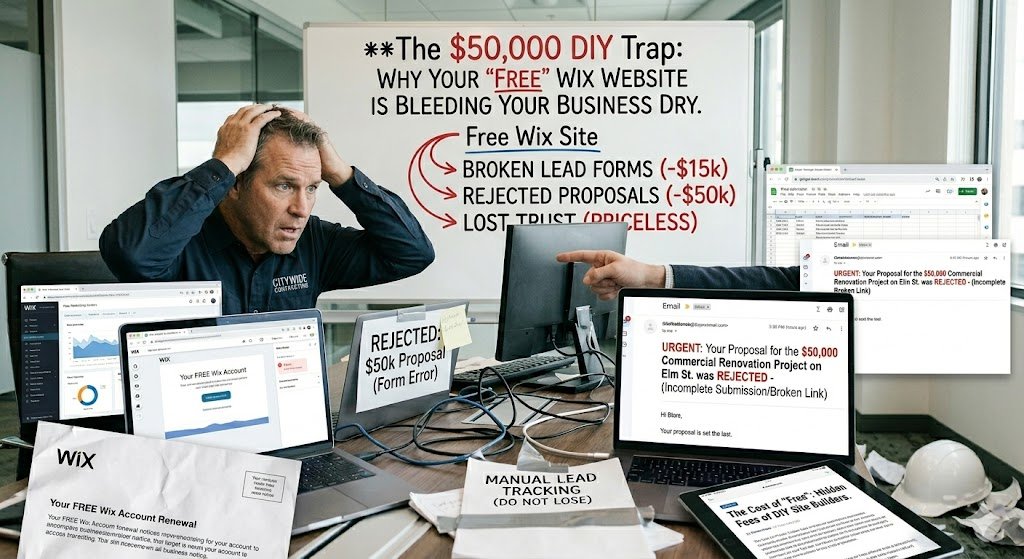
Every contractor remembers the early days. You bought a used truck, registered the LLC, and traded your sweat equity to save cash.
Somewhere around 11:00 PM on a Sunday, you sat down with a beer and built your own website using a free drag-and-drop template from Wix, Squarespace, or GoDaddy. You uploaded a fuzzy picture of your truck, typed out a list of your services, and called it a day.
When you are doing $250,000 a year and just need a digital business card to show to friends and family, that DIY hustle is necessary.
But here is the clinical reality: when you cross the $1 million revenue mark and start gunning for $5 million, the math completely flips. You now have heavy equipment loans, multiple crews to keep busy, and a dispatcher whose time is too expensive to waste on unqualified tire-kickers.
At this stage, relying on a DIY website is no longer “scrappy.” It is operational suicide.
If you are a mid-sized, hungry contractor trying to out-maneuver private-equity-backed regional franchises, you cannot fight a war with a plastic weapon. Here is the hard-nosed truth about why your DIY website is structurally breaking your business, forcing you to rely on shared lead brokers, and exactly why upgrading to a professional revenue engineering asset is the highest ROI move you can make.
The Brutal Opportunity Cost of a “Free” Website
When contractors balk at the cost of a professionally engineered website, they are looking at the wrong set of numbers. They think they “saved” $5,000 by doing it themselves.
What they don’t see is the Invisible Pipeline Leak.
When a violent storm snaps a tree onto a roof, or a homeowner’s basement floods, they do not care about your scrappy origin story. They search “emergency mitigation near me” or “roof replacement [City]” on Google. They want speed, trust, and authority.
If your DIY website takes 6 seconds to load on a mobile phone, or looks like it hasn’t been updated since 2015, they will hit the “back” button and call the PE-backed giant in your town.
You saved $5,000 on web design, but you just lost a $20,000 roof replacement to the guy down the street.
The 3 Fatal Flaws of the DIY Contractor Website
There is a massive difference between a website that “looks okay” and a machine-readable authority asset built to capture high-intent buyers. Here is where the DIY approach physically breaks down:
Flaw 1: AI and Google Cannot “Read” Your Site
Modern search has changed. Google is no longer just matching keywords; its algorithms and new AI Overviews (AIO) are actively reading the underlying code of your website to verify if you are a legitimate local authority.
DIY website builders spit out notoriously bloated, messy code. Worse, you cannot implement the advanced, hyper-local schema markup required to dominate the Map Pack. If your site doesn’t have structured data explaining exactly what high-ticket services you offer and the precise geographic coordinates of your service area, Google’s AI simply ignores you. You become digitally invisible.
Flaw 2: The Trust Gap on High-Ticket Projects
If you are selling a $250 service call to snake a drain, a basic template might suffice.
But if you are scaling, your goal is to sell $15,000 panel swaps, $20,000 HVAC wrap-and-replace jobs, or $35,000 custom composite decks. Selling complex, high-ticket project scopes requires deep trust. Your website must pre-sell your competence before the homeowner ever calls your dispatcher.
A DIY template cannot hold cinematic “Documercial” video assets without crashing the page speed. It doesn’t have the architecture to seamlessly display real-time, geotagged proof-of-work. When a homeowner lands on a cheap site to research a massive investment, their guard goes up. Your call-to-close ratio plummets, and your estimators burn out running to dead-end appointments where they are treated like a commodity.
Flaw 3: It Forces You to Rent Shared Leads
This is the deadliest flaw. Because your DIY website generates zero exclusive, organic inbound calls, your schedule runs dry.
Panic sets in, and you turn to lead brokers like Angi or HomeAdvisor. You start buying shared leads. But those brokers take the homeowner’s information and sell it to you and four other local roofers or plumbers at the exact same millisecond.
You are now paying for the privilege of entering a brutal race to the bottom on price. Your DIY website didn’t save you money; it forced you to rent your pipeline from a predatory broker.
The Math: The $1,500/mo Reality Check
Stop looking at a professional web presence as a vanity expense and start looking at the Return on Ad Spend (ROAS).
At Demand & Convert, we do not build “pretty brochures.” We engineer permanent digital real estate. And we do it using a transparent, standardized $1,500/mo framework. We don’t hide our pricing, and we don’t scale our fees just because you had a good quarter.
Let’s look at the financial mathematics of upgrading from a broken DIY setup to our professional capture system, assuming you target an average ticket size of $15,000 (like a new roof or custom deck).
Here is the clinical breakdown:
If your net profit margin on a $15,000 job is 35% (that is $5,250 in pure net profit), you do not need an agency to generate 200 garbage leads a month to prove their worth.
Mathematically, you only need to book one single high-ticket job every three months to cover our entire retainer. Everything after that is pure, compounding profit that permanently drives your Customer Acquisition Cost (CAC) down.
A DIY website cannot generate exclusive $15,000 jobs. A clinical, interconnected system can.
Stop Patching Leaks. Deploy the Tri-Engine System.
When you hire Demand & Convert, we don’t just hand you a new WordPress login and walk away. We replace your duct-taped DIY mess with our Tri-Engine Interlocking System.
This is how we help the underdog local operator completely dismantle the massive, private-equity-backed franchises in their territory:
1. The SEO Entity Handshake (Replacing the Invisible Template)
We scrap your slow DIY site and build a high-speed, machine-readable authority asset. We extract the exact EXIF GPS data coordinates from your field crews’ job-site photos and inject them directly into your local landing pages. This localized schema physically forces Google and AI answer engines (like ChatGPT and Perplexity) to recognize you as the dominant authority in high-net-worth zip codes.
2. Intent-Nested Paid Search (Filling the Pipeline Immediately)
While your organic moat is being built, we don’t waste budget on generic “brand awareness.” We deploy tightly themed Exact Match Ad Groups targeting high-intent emergencies (e.g., “emergency water heater replacement City”). These ads land on highly-optimized, conversion-tested service pages that turn clicks into booked dispatch calls instantly.
3. Social Proof Retargeting (Pre-Selling the High-Ticket)
If a homeowner visits your site but leaves to “think about it,” we don’t let them go. We track them and retarget them across Meta and Nextdoor with gritty, cinematic “Documercial” video assets. We show your branded fleet, your master tradesmen, and your clean job sites. By the time they call your office, the trust is already built.
Is Your Territory Still Open?
Scaling a contracting business past the $2M mark requires you to drop the ego of doing everything yourself. You have to stop acting like a desperate sub-contractor relying on cheap tools, and start acting like the dominant local authority demanding predictable systems.
If you are ready to ditch the DIY headache and stop renting your pipeline from lead brokers, you need to verify your eligibility.
Because we build total market dominance, Demand & Convert operates on a Strict Territory Lockout rule. We legally commit to working with only ONE contractor per trade, per territory. Once a roofer, plumber, or excavation crew locks in their core zip codes, we blacklist their local competitors from hiring us.
Our only objective is to weaponize your local brand and completely lock the competition out of the map pack.
Availability is incredibly limited.
Is your territory still open?
Talk to a Growth Engineer and Check Your Zip Code Availability Today

 The “Frankenstein” Marketing Stack: Why Your Duct-Taped Free Tools Are Costing You $30k Projects