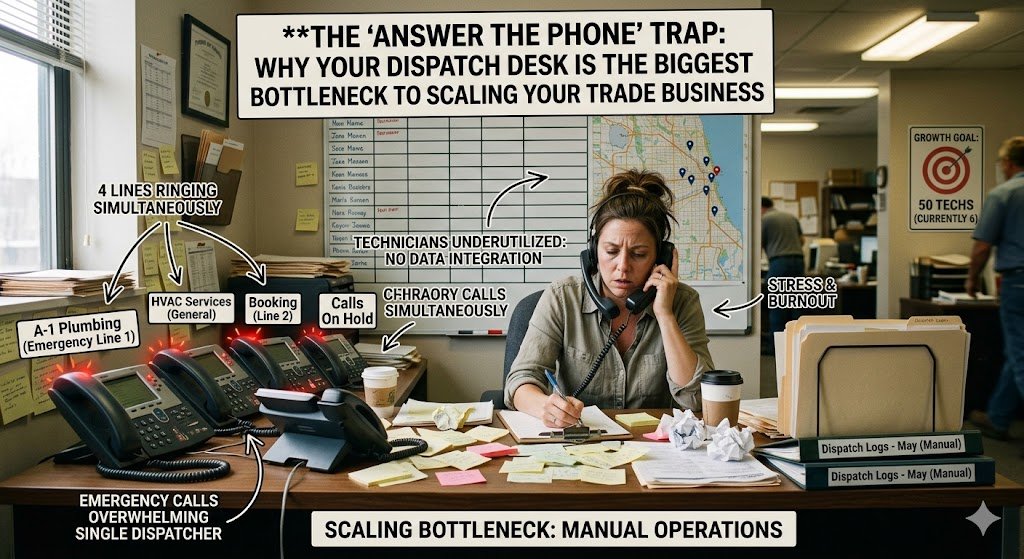
Every $1 million to $5 million contracting business has the exact same breaking point, and it is not in the field. It is sitting behind a desk.
When you started, you answered every call. Then you hired an office manager or dispatcher to “handle the phones” so you could focus on operations and sales.
At first, it worked. But as your marketing spend increased and your customer base grew, the volume of incoming communication became a flood.
Now, walk into your office and watch your dispatcher for an hour.
They are stuck on a 15-minute call explaining your $150 diagnostic fee to a homeowner who thinks estimates should be free. They are manually typing out text messages to tell a customer the crew is running 20 minutes late. They are answering the same “do you pull the permits for this?” question for the fifth time today.
While they are bogged down fighting these low-value brushfires, a high-intent buyer calls to schedule a $25,000 custom deck or a full HVAC replacement. The call goes to voicemail.
You didn’t build a business; you built an incredibly stressful call center.
If you are a mid-sized, hungry contractor trying to out-maneuver the private-equity-backed franchises in your territory, you cannot afford to burn out your front office and leak high-ticket leads. Here is the clinical truth about why “just hire another dispatcher” is the wrong answer, and the exact mathematical blueprint to fix it using automated revenue engineering.
The Brutal Cost of the “Human Bottleneck”
Most owners try to solve dispatch burnout by throwing more bodies at the problem, or simply telling their team to “work faster.” But relying on manual hustle for repetitive tasks is structurally flawed.
Here is where the pipeline breaks down:
- The Shared Lead Distraction: If you are buying shared leads from brokers like Angi or HomeAdvisor, your dispatcher’s life is a nightmare. They are spending 30 hours a week aggressively dialing cold leads, arguing over price with people who submitted their info to five different local competitors simultaneously. They aren’t dispatching; they are fighting for scraps.
- The Information Void: If your website is just a generic digital brochure with a phone number, it provides zero utility. It forces the homeowner to call to get basic answers about pricing models, service areas, or material warranties. Your dispatcher becomes a human FAQ page.
- The “Ghosted” Trust Asset: Homeowners expect seamless, modern communication. When an overwhelmed office fails to send automated appointment confirmations, “on-the-way” text updates, or post-job review requests, the customer feels neglected. The friction destroys your close rate.
You are paying a premium salary to a staff member to do the work of a machine, while the high-ticket relationship building is completely ignored.
The Mathematical Reality of Dispatch Efficiency
Stop looking at marketing as just “making the phone ring” and start looking at the Cost of Goods Sold (COGS) on your front office time.
Let’s look at the financial mathematics of replacing manual hustle with our Demand & Convert $1,500/mo Tri-Engine System, assuming you target a $15,000 average ticket size.
At Demand & Convert, we do not hide our pricing. If your net profit margin on a $15,000 job is 35% (that is $5,250 in pure net profit), mathematically, you only need to book one single high-ticket job every three months to cover our flat $1,500/mo retainer.
By building systems that pre-qualify and pre-educate, we don’t just generate leads; we drastically reduce the sheer volume of bad calls your office has to field, freeing them to close the highly profitable work.
The Actionable Blueprint: Automating the Friction
You cannot fix an overwhelmed dispatch desk by yelling at your staff. You must build systems in layers.
When you partner with Demand & Convert, we deploy our Tri-Engine Interlocking System to not only capture new intent, but to filter and automate the communication before the phone ever rings. Here is how we engineer efficiency:
1. Answer-First Digital Architecture (Eliminating the Human FAQ)
We restructure your website to handle the heavy lifting of customer communication.
We do not build generic “About Us” pages. We deploy structured, “Answer-First” FAQ sitemaps. We answer complex questions about project scopes, permitting, financing options, and diagnostic fees explicitly on the page.
We format this content using hyper-local schema markup. This physically forces Google and AI answer engines (like ChatGPT and Perplexity) to index these answers. When a homeowner searches, “Does [Your Company] charge a dispatch fee?”, the AI answers it for them. The phone only rings when they are ready to book.
2. Social Proof Retargeting (Pre-Selling the High-Ticket)
When a customer lands on your site and leaves to “think about it,” they usually call back later with a dozen questions.
We eliminate this by tracking them and retargeting them across Meta (Facebook/Instagram) and Nextdoor. We deploy gritty, cinematic “Documercial” video assets. We show your master tradesmen explaining the installation process, the materials used, and your clean job sites.
By the time they call your dispatcher, the trust is already built. They aren’t calling to interrogate you about your process; they are calling to get on the schedule.
3. Owning Your Pipeline (Starving the Lead Brokers)
The fastest way to reduce front-desk burnout is to stop buying shared leads from HomeAdvisor.
We deploy tightly themed Exact Match Ad Groups (STAGs) targeting only immediate, high-intent emergencies (e.g., “emergency water heater replacement [City]”). Furthermore, we run interlocking bid arbitrage: when your organic SEO ranks #1 in a specific neighborhood, we dial down your paid ad spend there, reallocating it to conquer new suburbs.
Your dispatcher goes from fighting five other contractors for a $200 service call to fielding exclusive, high-intent inquiries from homeowners who specifically searched for your brand.
Is Your Territory Still Open?
Scaling a contracting business past the $2M mark requires you to drop the ego of doing everything manually. You have to stop acting like a frantic sub-contractor relying on duct-taped tools and an exhausted front desk, and start acting like the dominant local authority demanding predictable, automated systems.
If you are ready to stop burning out your dispatchers and start turning your pipeline into a high-ticket closing machine, you need to verify your eligibility.
Demand & Convert operates on a Strict Territory Lockout rule. We legally commit to working with only ONE contractor per trade, per territory. Once a roofer, plumber, or HVAC crew locks in their core zip codes, we blacklist their local competitors from hiring us.
Our only objective is to weaponize your local brand, automate your friction, and completely lock the competition out of the map pack.
Availability is incredibly limited.
Is your territory still open?
Talk to a Growth Engineer and Check Your Zip Code Availability Today

 The $1M to $5M Chasm: Why Scaling Your Contracting Crews is Structurally Breaking Your Customer Retention (And Bleeding Your Referral Pipeline)