
For certified home service professionals and commercial contractors operating in highly competitive local service cities, building AI-verified Entity Authority is the only proven method to secure exclusive, high-ticket leads and protect your pipeline from low-bid competitors.
Introduction: Why Your Phone Isn’t Ringing (The AI Era)
For the last decade, local contractors—from paving and plumbing to foundation repair and landscaping—have played by a simple rule: stuff enough keywords onto a webpage, buy enough links, and you’ll rank on Google.
In 2026, that era is over.
When a panicked homeowner searches for an “emergency plumber near me” or a property manager asks ChatGPT, “Who are the most reliable commercial demolition contractors in Dallas?”, they aren’t getting a list of blue links anymore. They are getting AI-generated answers. Search engines like Google (via AI Overviews), Perplexity, and ChatGPT don’t just match keywords; they evaluate Entities.
If your phone has stopped ringing from organic search, it’s likely because AI models don’t trust your business entity.
To win high-ticket, inbound leads today, your strategy must shift from “ranking for keywords” to “building Entity Authority.” Entity Authority is the measure of how deeply AI models trust your brand as a legitimate, safe, and expert local operation.
Here is exactly how to build it through the four core pillars of the AI era: Consistent NAP Data, Schema Markup, GBP Signals, and Authoritative Content.
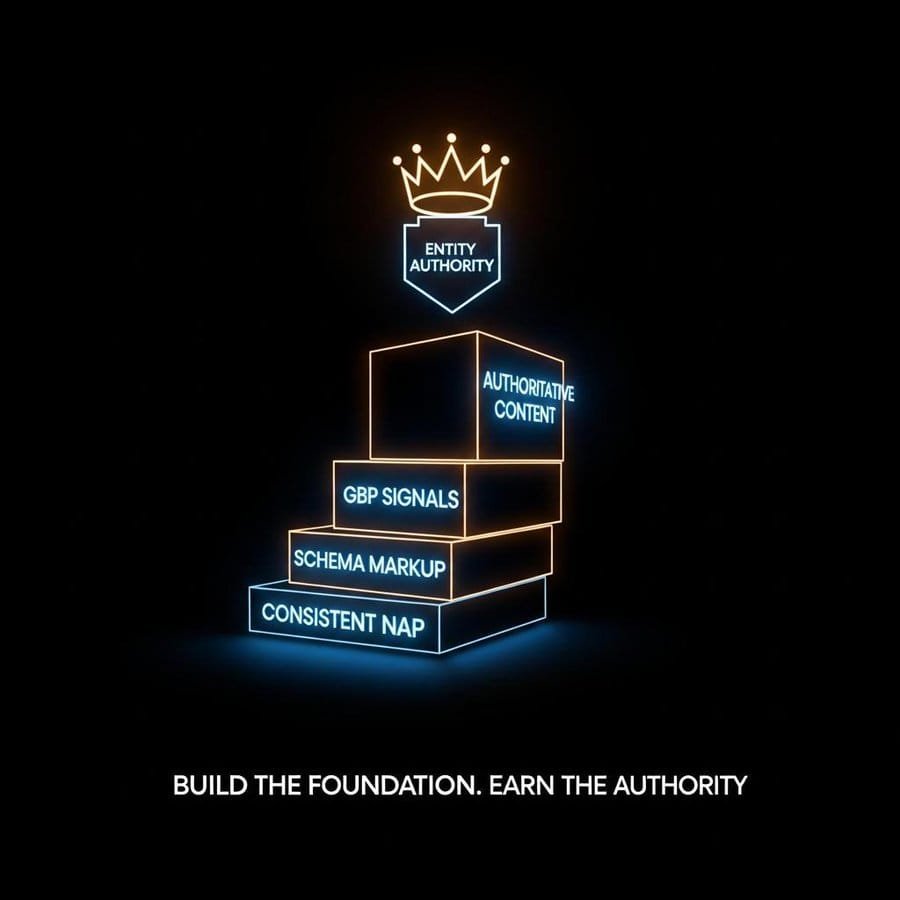
Pillar 1: Consistent NAP Data (The Digital Fingerprint)
To an AI algorithm, your business isn’t a physical office or a fleet of branded trucks; it’s a collection of data points. The most foundational data point is your NAP: Name, Address, and Phone Number.
When ChatGPT or Google’s AI evaluates your business to see if it should recommend you for a $30,000 solar installation or a massive commercial excavation job, it looks for consensus across the web.
- The Problem: If your website says “Smith’s Roofing,” your Yelp profile says “Smith Roofing LLC,” and your BBB profile lists an old phone number, the AI model gets confused. Confusion equals a lack of trust. If it can’t verify exactly who you are, it will recommend your competitor instead.
- The Fix: Exact, flawless consistency.Use your exact operating name. Do not add keywords (e.g., never use “Smith Roofing Dallas” if your legal name is “Smith Roofing”). Ensure your address is identical down to the suite number or “St.” vs. “Street.”Build this consistent footprint across high-trust directories. For home services, this means claiming and perfectly matching your profiles on the Better Business Bureau (BBB), Nextdoor, Yelp, and commercial directories like The Blue Book.
Pillar 2: Schema Markup (The AI Translator)
AI models process millions of data points a second. You need to make it as easy as possible for them to extract your business details. You do this using Schema Markup.
Schema is code on your website that acts as a direct translator for search engines. Instead of forcing Google’s AI to read a paragraph of text to figure out what services you offer and where you are located, Schema hands the AI a perfectly formatted business card.
- LocalBusiness Schema: This tells the AI your exact coordinates, operating hours, accepted payment methods, and specific service category (e.g., HVACContractor or Plumber).
- FAQ Schema: When you answer common customer questions on your site (e.g., “How much does an electrical panel upgrade cost?”), FAQ Schema feeds those direct answers straight into Google’s AI Overviews.
- Organization Schema: This ties your brand name to your founders, your social profiles, and your verified reviews, solidifying your entity in the Knowledge Graph.
Pillar 3: GBP Signals (The Proof of Life)
Your Google Business Profile (GBP) is the most valuable real estate in your local market. It is also the primary data feed for Google’s local AI models. AI systems are specifically trained to filter out “scam” or “fly-by-night” operations—a massive issue in industries like pest control, moving, and paving. Your GBP must prove you are a living, breathing, professional operation.
- Visual Proof: Upload 20+ high-quality photos. AI can analyze images. Show your heavy equipment, your branded fleet, uniformed technicians, and satisfying Before & Afters. Pro-Tip: Rename your image files before uploading to include the service and city (e.g., commercial-asphalt-paving-phoenix.jpg) and embed geo-tags.
- Active Q&A Seeding: Don’t wait for customers to ask questions. Seed your own GBP with 10+ common FAQs (e.g., “Are your technicians background-checked?” or “Do you handle the city permits?”) and answer them thoroughly to project safety and transparency.
- Review Sentiment & Response: AI tools don’t just count your stars; they read the text. Reviews mentioning “handled the insurance adjusters,” “didn’t cut corners,” or “left the site spotless” act as massive positive sentiment triggers. You must respond to every single review within 48 hours, thanking the customer by name and mentioning the specific service provided.
Pillar 4: Authoritative Content (The Semantic Web)
In the AI era, publishing generic 500-word blog posts is a waste of time. Content must be engineered to be “extractable” by systems that process context windows at high speed.
At Demand & Convert, we call this the TurboQuant Strategy. You build content authority by reducing the “semantic distance” between your brand and the local services you provide.
- Answer-First Design: AI systems like Perplexity and Google’s AI Overviews pull “fact-checkable snippets.” You must lead every FAQ or service section with a direct, 2-to-3 sentence answer before diving into the technical explanation.
- Hierarchical Integrity: Maintain strict H2-to-H3 heading structures on your service pages. Never skip heading levels. This makes your content 40% more likely to be cited by Large Language Models (LLMs).
- Location Support Articles: Build a network of 10-20 articles that prove you are a genuine local authority. Don’t just write about “how to fix a roof.” Write about “How [City]’s Freeze/Thaw Cycles Destroy Asphalt Driveways” or “Navigating HOA Approvals for Decks in [City].” This links your entity directly to the geographic reality of your service area.
The Bottom Line for 2026
AI recommendation engines are ruthless. They actively filter out contractors with mismatched data, poor brand sentiment, and thin websites. Building Entity Authority isn’t a one-time SEO trick; it’s a commitment to proving your legitimacy to machines the same way you prove it to a homeowner at their front door.
If you dominate your NAP consistency, translate your site with Schema, actively manage your GBP signals, and publish extractable, answer-first content, you won’t just rank on Google. You will become the only brand the AI recommends.
Ready to see how your local entity holds up against the competition? Contact Demand & Convert todayfor a comprehensive 2026 Local SEO Gap Assessment.
Subject Matter Context
Core Pillar Connection: This technical guide is part of our Contractor Aeo Answer Engine Optimization series. For comprehensive execution and guaranteed results in your local area, review our official protocol: AI Answer Engine Optimization (AEO) and Entity Mapping .
Related Contractor Aeo Answer Engine Optimization Resources:
- • The HVAC SEO Playbook: Building an Engine That Drives Constant Local Leads
- • 4 Content Optimization Tips to Help Your Contracting Business Stand Out and Win High‑Ticket Jobs
- • How AI Search is Stealing Your $15k Installs (And How to Hijack the Algorithm)
- • The AI Invisibility Crisis: Standard sites hide critical data. We embed machine-readable code.
- • The Core Vitals Gap

 7 Search Engine Advertising Techniques Local Contractors Use to Win High-Ticket Jobs