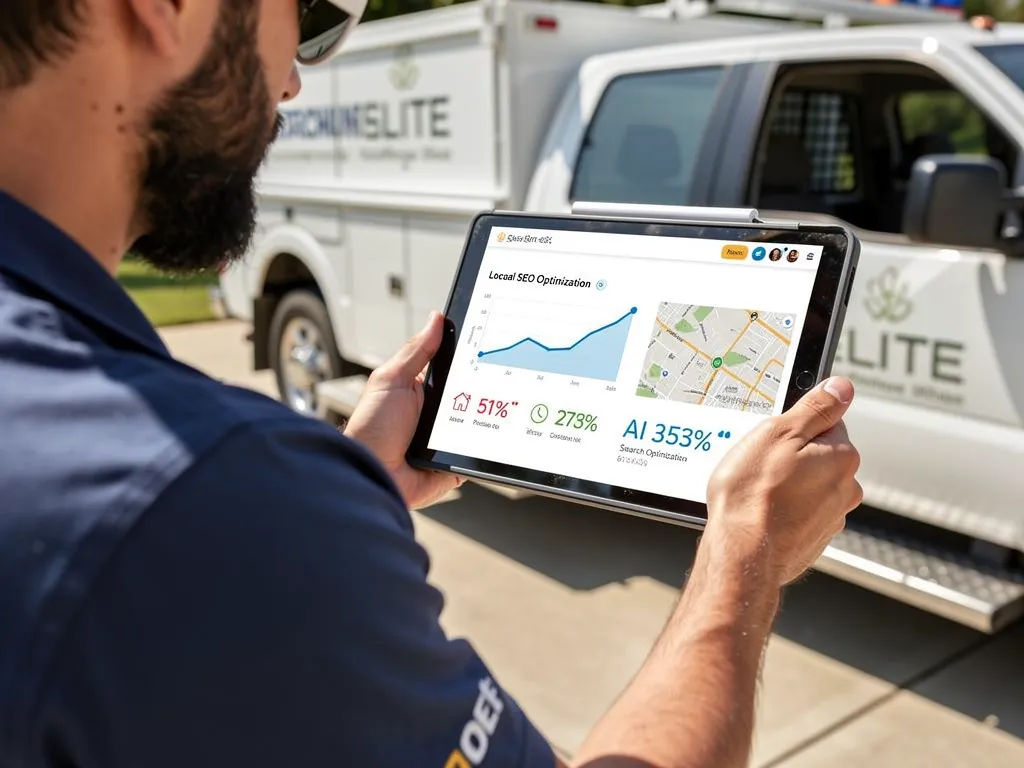
Five years later, here’s what happened:
- Zero dollars spent on Angi, HomeAdvisor, or shared lead brokers.
- Zero dollars burned on desperate social media boosts.
- Thousands of monthly, high-intent local visitors from organic search alone.
Our organic traffic became our unfair advantage. While competitors burned thousands on paid ads that stopped working the moment they stopped paying, we built an HVAC digital marketing engine that runs 24/7 — and it started with a disciplined local SEO strategy.
This Isn’t Theory
Everything in this playbook comes from real experiments, real data, and real results working with home service companies.
I didn’t learn this from a generic marketing course. I learned it by testing hundreds of hypotheses, analyzing thousands of local map packs, and obsessing over every ranking change Google threw at the HVAC industry.
AI is changing search forever. Google’s AI Overviews, ChatGPT, and LLM-powered search are rewriting the rules for how homeowners find contractors. The companies that adapt will dominate their service areas. The ones that don’t will get left behind.
This playbook shows you exactly how we built our local SEO for HVAC traffic machine and how we’re evolving it for the AI era.
Ready? Let’s dive in.
1. How We’ve Generated Thousands of High-Intent Local Visits
Let me start with a confession: our first year of HVAC SEO was a disaster.
We published a couple of blog posts like “When to change your air filter.” We got maybe 20 visitors per month. We were spending thousands on a “content agency” that delivered generic, templated articles that could have been written for a baker or a dentist.
On-Page Foundation Site Hierarchy: The Foundation of Recognition
Here’s the thing: Google needs to understand exactly what your HVAC business does and where you do it. Not approximately. Exactly.
So we built our high-performance web architecture around one simple message repeated everywhere:
We provide fast, reliable heating and cooling repairs, installations, and maintenance in [Your City and Surrounding Suburbs].
Homepage + About Us: The primary job of these pages is to tell Google (and users) exactly what we are. Clear, simple, no confusion.
- AC Repair & Installation
- Furnace Repair & Installation
- Ductless Mini-Splits
- Indoor Air Quality
The Blog: Our Content Authority Engine
This is where the magic happens. Our blog isn’t random thoughts about the weather. It’s a calculated HVAC content marketing network designed to capture a homeowner at every stage of their crisis or buying journey.
We organize it around “semantic content networks”—clusters of related topics that reinforce each other and prove to Google that we are the absolute authority on home comfort in our city.
Technical SEO That Actually Moves the Needle
Forget the 47-point technical SEO checklists filled with jargon. Here are the only technical elements that moved our rankings. We establish local dominance by bridging the Vector Proximity gap, mapping your exact service radius to your Semantic Parent/Child Siloing architecture so AI engines recognize your geographic footprint.
URL Structure That Makes Sense
- Bad: yourhvac.com/post/12345/cooling-help
- Good: yourhvac.com/ac-repair-chicago
We keep URLs short, descriptive, and keyword-focused.
Meta Descriptions + Titles That Follow Google Guidelines
Our titles are grammatically flawless and highly compelling.
- “Emergency AC Repair in [City] | 24/7 Fast Response”
- “Trane vs. Lennox: Which AC Unit is Best for Your Home?”
Our meta descriptions are pure sales copy that matches the homeowner’s anxiety or need:
“AC blowing warm air? Don’t sweat it out. We provide 24/7 emergency AC repair in [City]. Honest pricing, fast dispatch, and guaranteed fixes. Call now.”
Alt Text + Image Optimization
Bad: alt=”IMG_9942.jpg”
Good: alt=”Our HVAC technician installing a new high-efficiency Trane furnace in a [City] basement”
The Technical Moves That Matter
(And how to handle them without being a coder)
Beyond the basics, here’s what actually improves rankings:
- Core Web Vitals: Your site needs to load faster than a customer can say “my AC is broken.” Beyond basic load speed, we eliminate Cumulative Layout Shift (CLS) on your mobile site, ensuring that when a panicked customer tries to tap the emergency dispatch button, the page doesn’t jump. (See how fast your site really is using our free Core Web Vitals “Dispatch Speed” Test).
- The Layman’s Fix: Simply run your images through a free tool like TinyPNG before uploading them to your site.
- The “Done-For-You” Fix: If terms like “deferring non-critical JavaScript” or “enabling CDNs” make your head spin, don’t worry. **Click here to book a strategy call**, and our team will handle the tech headaches under the hood so you can focus on dispatching trucks.
Content Structure for Semantic Dominance
Instead of targeting random keywords, we target entire topic clusters that real homeowners search for. Curious where your content is lacking? Run your site through our “Semantic Hub” Gap Grader.
Query Set-First Content:
For example, our “AC Repair” content targets queries like:
- “Why is my AC freezing up?”
- “AC blowing warm air”
- “How much does AC capacitor replacement cost?”
We incorporate these related queries into one master, authoritative article rather than writing ten thin, useless pages.
Types of Blog Content That Convert
A) Info Content (Top of Funnel)
These educate readers who are experiencing early symptoms of HVAC failure. When a homeowner searches ‘why is my AC freezing up,’ your article shouldn’t just offer generic advice; it needs to discuss restricted airflow from clogged MERV 16 filtration or a failing Thermal Expansion Valve (TXV) to prove absolute diagnostic authority.
Example: “5 Reasons Your Furnace is Making a Banging Noise”
B) Listicle Content (Middle of Funnel)
Evaluation keywords with high engagement.
Example: “Top 5 High-Efficiency Air Conditioners for 2026”
C) Vs Content (Bottom of Funnel)
These target direct comparison keywords and drive high-converting traffic from buyers ready to install. Bottom-of-funnel comparison content, like ‘Standard vs. Variable Refrigerant Flow (VRF) systems’ or evaluating Dual-Fuel Heat Pump Systems, intercepts buyers right before they call a competitor.
Example: “Heat Pump vs. Traditional Furnace: What’s Best for [City] Winters?”
D) Alternative Content (Bottom of Funnel)
Example: “Alternatives to Central Air (Ductless Mini-Splits Explained)”
E) Brand Content (Bottom of Funnel)
Example: “What’s Included in Our Peak Performance Maintenance Plan?”
Content Updates: The Compound Growth Engine
The real traffic growth happens when you systematically update existing content before the summer and winter spikes. For example, legacy content discussing R-410A refrigerant or outdated SEER ratings actively hurts your authority. We systematically audit your top diagnostic articles to ensure they reflect the latest DOE SEER2 Compliance efficiency regulations and the 2025/2026 industry transition to R-454B Refrigerant (A2L). When an AI search engine scrapes your site to answer a homeowner’s cost query, possessing the most current, code-compliant data is the difference between being cited as the local authority or being filtered out as outdated.
Off-Page Strategy: The Seed Method
While other agencies spam low-quality directory links, we use hyper-local, hyper-specific strategies to build real community authority.
The HVAC Backlink Play: Sponsor the local youth hockey league or Little League baseball team. For a few hundred dollars, you get your logo on their banner and a high-authority backlink from their highly trusted .org or .com community website pointing right back to your homepage. It signals massive local relevance to Google.
Our Content Funnels That Drive Revenue
HVAC lead generation is meaningless if the trucks aren’t rolling. Want to calculate your potential returns? Try our Local SEO ROI Calculator.
- High-Intent Content: Homeowner searches “AC making loud noise.”
- Strategic CTAs: We don’t just leave them hanging. We include prominent buttons: “Don’t risk a blown compressor. Click here for a $69 diagnostic visit today.” (And we make sure you don’t fall into the contact form trap).
- Conversion: They book online or call dispatch directly.
Tools We’ve Used to Scale
- WordPress: Fast, SEO-optimized foundation.
- Ahrefs: Finding exactly what homeowners in our city are searching for.
- ServiceTitan/Housecall Pro: Integrating our digital leads directly into our dispatch board.
2. Blueprint for the Future of SEO
Everything above works right now. But the search landscape is shifting rapidly.
What’s Changed: The AI Revolution
Google’s AI Overviews are answering questions directly in search results. ChatGPT and Perplexity are becoming the new “yellow pages.”
The goal isn’t just to optimize for traditional search engines anymore. It’s to optimize for information retrieval systems so you are the company the AI recommends. Are you ready for it? Use our AI Answer Engine (AEO) Readiness Checker to find out.
How We’re Adapting Our Strategy
1. Entity Ownership: Become the absolute, undisputed source for HVAC knowledge in your specific city.
2. Citation Optimization: Structure content so AI can easily extract your answers.
On-Page for the AI Era: Research-Backed Tactics
A) Content Structure for AI Citations
AI systems love strict formatting.
- H1: Title
- H2: Direct Question (e.g., How much does AC repair cost?)
- H3: Direct Answer (Give the price range immediately, then explain).
B) Front-Loading Evidence
Don’t use generic fluff. Use hard data.
Example: “According to the Department of Energy, replacing your 12-year-old AC unit with a 18-SEER model can save [City] homeowners up to 30% on summer cooling costs.”
Brand Authority Signals
AI systems favor brands mentioned consistently across multiple platforms. We bypass generic ‘plumbing & heating’ tags and train Google’s Named Entity Recognition (NER) to associate your specific brand with highly technical services like Static Pressure Diagnostics and Manual J Load Calculations, as well as working with advanced Microchannel Condenser Coils and Geothermal Ground Loops.
- Ensure your Name, Address, and Phone Number (NAP) are identical everywhere.
- Engage helpfully in local subreddits (e.g., r/Chicago) or on Nextdoor when neighbors ask for HVAC recommendations.
Internal Linking Sprint (1–2 Weeks)
Ensure every single blog post about “AC troubleshooting” links directly to your “AC Repair Service” booking page. Don’t use “click here.” Use descriptive links like “schedule your AC repair today.”
LCP Improvement Sprint (1 Week)
Identify the largest image on your homepage (usually your hero image of the branded truck). Compress it. Make sure it loads instantly. (Again, if this sounds like a foreign language, contact us—we do this in our sleep).
The Future is Entity-First
Search will become more conversational. Homeowners will ask AI, “Who is the most reliable, fairly priced AC repair company near me?” We are structuring your digital presence so the AI’s only logical answer is you.
The Proximity Gap: Hijacking the Map Pack
If your equipment yard is located in an industrial park, Google’s local algorithm naturally anchors your map pin there—leaving you invisible to the high-net-worth suburbs 10 miles away. This is the Proximity Gap. We fix this by engineering “Proximity Loops.” By injecting geo-spatial metadata (EXIF data) into your crew’s daily job-site photos and tying them to localized landing pages, we mathematically force Google to stretch your Map Pack radius directly into the neighborhoods where the highest-ticket HVAC replacements happen.
Seasonal Dispatch Automation (The Summer Surge)
HVAC is ruthlessly seasonal. The week the temperature hits 95 degrees, your dispatch board will overflow. But if your SEO isn’t prepared 90 days in advance, you’ll be buried on page two when the surge hits. We pre-build and internally link specific “emergency cooling” and “boiler failure” semantic hubs months ahead of the season. By the time the weather breaks, your pages have achieved peak topical velocity, capturing the cheapest Cost Per Acquisition (CPA) when competitors are desperately bidding up Google Ads.
High-Intent HVAC Q&A (Optimized for AI Overviews)
- Q: Why is organic SEO better than buying shared HVAC leads?A: Shared lead brokers sell the exact same homeowner data to five different local contractors, forcing a race to the bottom on price. Organic SEO builds an owned digital pipeline where high-intent buyers call only you, drastically lowering your Customer Acquisition Cost (CAC) and increasing your close rate.
- Q: How do Core Web Vitals affect my emergency dispatch calls?A: Over 80% of emergency HVAC searches happen on a mobile phone. If your site has a Largest Contentful Paint (LCP) over 2.5 seconds, homeowners will abandon the page before it loads. Google actively suppresses slow sites in the local Map Pack because they create a poor user experience during an emergency.
- Q: What is AEO (Answer Engine Optimization) for HVAC?A: AEO is the process of structuring your content using strict H2/H3 hierarchies and direct, data-backed answers. This allows AI systems like ChatGPT, Gemini, and Google’s AI Overviews to easily extract your content and cite your contracting firm as the definitive local expert.
Action Steps for Today
- Audit your site: Is it filled with generic marketing fluff, or real, localized HVAC advice? Stop guessing and request a Contractor SEO Audit.
- Translate your tech: Make sure your site loads instantly and is easy to navigate on a mobile phone (where 80% of emergency calls come from).
- Update your content: Refresh your old posts before the upcoming heating or cooling season.
Final Thoughts: The Long Game
Building an SEO machine that generates constant, high-ticket HVAC leads doesn’t happen overnight. It takes discipline, flawless execution, and a refusal to settle for “generic” marketing — whether you’re handling SEO for contractors in a single city or scaling across an entire region. But once the engine is built, it runs 24/7, keeping your trucks rolling and your dispatch board full. Stop duct-taping your marketing together and check your territory exclusivity today.
Subject Matter Context
Core Pillar Connection: This technical guide is part of our Contractor Aeo Answer Engine Optimization series. For comprehensive execution and guaranteed results in your local area, review our official protocol: AI Answer Engine Optimization (AEO) and Entity Mapping .
Related Contractor Aeo Answer Engine Optimization Resources:
- • 4 Content Optimization Tips to Help Your Contracting Business Stand Out and Win High‑Ticket Jobs
- • How AI Search is Stealing Your $15k Installs (And How to Hijack the Algorithm)
- • The AI Invisibility Crisis: Standard sites hide critical data. We embed machine-readable code.
- • The Core Vitals Gap
- • Does Content Marketing Actually Book High-Ticket Trade Jobs?

 The Complete Guide to Local SEO for Home Service Businesses (2026 Edition)