
Yes, high-authority contractor content marketing directly books high-ticket jobs by intercepting anxious property owners during their active research phase and pre-selling them on your technical competence before your estimator ever walks the property. While cheap, AI-generated blog posts fail, semantically engineered topic hubs structured for Google’s vector search infrastructure consistently capture high-margin installations—such as $15,000 panel upgrades, $20,000 roof replacements, and $30,000 crawl space encapsulations—completely bypassing predatory, shared-lead middleman networks.
The Shared Lead Trap: Squeezing Your Margins to Zero
Every month, thousands of home service business owners log into portals like Angi, HomeAdvisor, and Thumbtack, hoping to feed their field crews. Instead, they get caught in a mechanical margin squeeze.
Here is how the shared-lead broker loop actually works:
- A homeowner notices a stair-step crack in their exterior brick or a growing water stain on their drywall. They search Google for an answer.
- A multi-billion-dollar lead aggregator intercepts that click with a generic, template-built landing page.
- The homeowner inputs their phone number, thinking they are contacting a single local business.
- The aggregator packages that contact information and sells it to four or five local trade contractors within the exact same millisecond.
- Your office team is forced into a brutal “speed-to-lead” race, frantically calling a prospect who is simultaneously being bombarded by four other competitors.
This model transforms your highly specialized trade into a commoditized, lowest-bidder auction. You are forced to compete on price, cutting your margins to the bone just to keep your trucks moving.
When you rely on shared leads, you do not own a B2B pipeline; you are renting customer access from a broker who can double your dispatch fees or cut off your lead volume overnight. The only way to build a resilient, multi-million-dollar contracting brand is to transition from renting leads to owning permanent digital real estate.
The Brutal Mathematics of Cold Traffic vs. Topical Authority
Traditional marketing agencies love to report on “vanity metrics” like impressions, total page views, and generic click-through rates. But B2B operators and established trade contractors do not pay their technicians in “likes.”
Let us analyze the hard financial mathematics of running paid search traffic to a flat, unoptimized website versus deploying a high-authority content ecosystem under our flat-rate $1,500/mo framework.
The Paid Search (PPC) Friction Model
If you run Google Ads to capture emergency queries (e.g., “emergency sewer line replacement”), you are buying cold, skeptical clicks.
- Average Cost-Per-Click (CPC) in high-ticket niches: $35.00 to $75.00
- Average click-to-lead conversion rate on a standard template site:
- $10%$
- Average lead-to-booked job close rate on cold search traffic:
- $15%$
Using these benchmarks, let us calculate the Customer Acquisition Cost () on a cold search campaign targeting a major system installation:
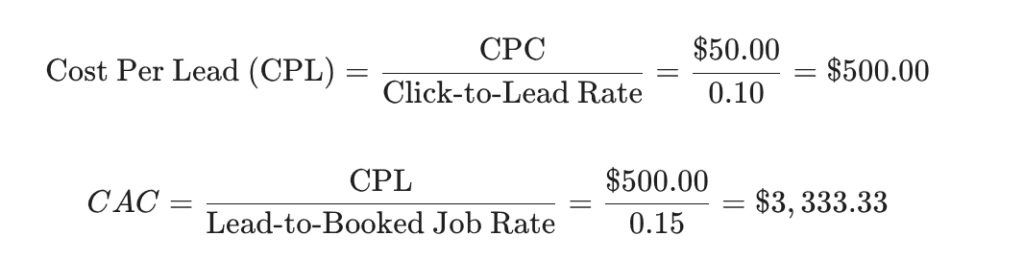
Paying over $3,300 to secure a single booked installation severely drains your cash flow, even on a high-ticket project.
The Compounding Organic Authority Model
Now, let us analyze the math of semantically engineered contractor content. When you publish expert-led, highly structured content, you intercept the buyer during their research phase. By answering pre-purchase anxieties around local building codes, permitting, and material costs, you eliminate “stranger danger” and pre-sell your crew’s clinical capability.
Let us model the break-even project velocity () for an excavation or foundation repair contractor utilizing our $1,500/mo program.
$V_{be}$
- Monthly Retainer: $1,500
- Average Project Ticket Size: $12,000 (e.g., heavy lot clearing, structural piering, or basement waterproofing)
- Net Profit Margin:
- $35%$
To calculate how many completed high-ticket jobs are required per quarter to completely cover your marketing investment, we use the following structural equation:
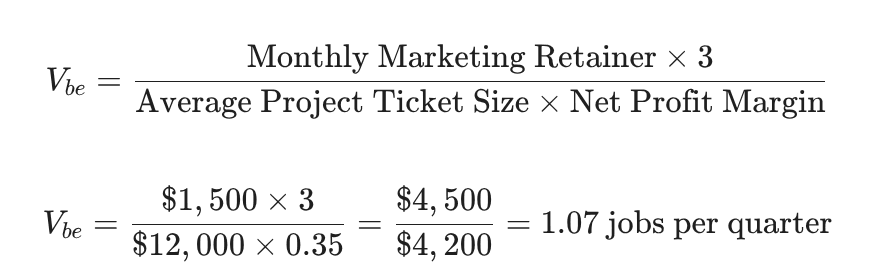
To achieve a complete break-even on your marketing spend, your content engine only needs to produce 1.07 signed contracts every 90 days. Every additional job secured past that single project is pure profit. Once your organic topic hubs rank in the top positions of Google and AI search engines, they generate passive, exclusive phone calls year-round with zero paid cost-per-click.
How We Structure Content to Pre-Sell $15k+ Installs
We do not write generic, cheap, AI-generated blog posts that tell homeowners to “clean their gutters in the spring.” Google’s vector search infrastructure (such as TurboQuant) easily detects and filters out that shallow filler. To capture high-ticket installations, your content must be structured as highly operational “Trust Assets” organized into three distinct intent phases.
Phase 1: Capturing TOFU Symptoms (The “Ceiling Stain” Strategy)
Homeowners do not search for “asphalt shingle underlayment replacement” or “heavily reinforced steel push piers” when their property begins to experience failure. They search for the visible, physical symptom of the underlying crisis.
- Target Queries: “why is my ceiling stain growing after rain,” “stair step crack in exterior brick wall,” “musty smell coming from crawl space vents.”
- The Copy Architecture: We do not write dry dictionary entries. We produce immediate, direct, answer-first layouts. We explain the technical cause of the symptom, instantly positioning your trade brand as the local educator rather than an aggressive, commission-hungry salesperson.
Phase 2: Intercepting MOFU Comparison (Brand vs. Brand Battle)
Once a property owner realizes they have a major structural or system issue, they begin researching materials, manufacturers, and compliance options.
- Target Queries: “GAF Timberline UHDZ vs Owens Corning Duration,” “Trex vs TimberTech composite deck cost,” “tankless water heater vs traditional tank lifespan.”
- The Copy Architecture: We write detailed, data-rich product comparisons. We detail specific wind ratings, warranties, local temperature tolerances, and installation complexities. When a homeowner reads a clinical breakdown comparing major manufacturers on your site, they naturally assume you are the factory-certified master tradespeople best equipped to install them.
Phase 3: Locking Down BOFU Intent (Upfront Cost Math)
Before committing to a physical site walk or scheduling an on-site estimator, high-value buyers research the financial and regulatory scope of the project.
- Target Queries: “how much does it cost to clear a wooded acre in [City],” “do I need a permit to upgrade to a 200 amp panel in [State],” “crawl space encapsulation cost breakdown.”
- The Copy Architecture: We write transparent pricing guides. We lay out the exact variables that impact cost—detailing soil properties, municipal permitting fees, labor times, and hazardous materials. By answering the scary “how much is this going to cost” question with honest, engineered numbers, we filter out cheap tire-kickers and ensure your estimators only drive out to high-intent, quote-ready properties.
The Technical Framework: Feeding Google’s Vector Search Engine
To win in the modern search landscape, your copy cannot just look “pretty” to a human reader—it must be structurally engineered for machine-reading crawlers, Large Language Models (LLMs), and Retrieval-Augmented Generation (RAG) frameworks.
Strict Hierarchical Nesting (H2 -> H3)
Google’s modern document parsers calculate semantic distances between headers. If your website code jumps randomly from an H1 to an H4, or utilizes non-standard header tags to style text, crawling bots get confused and immediately drop your ranking.
We structure every single piece of copywriting into strict, cascading hierarchical blocks:
- H1: The main transactional keyword or target query question.
- H2: Direct, high-density conceptual answers.
- H3: Bulleted lists, material specifications, and regulatory codes.
This clean structural footprint ensures ChatGPT, Claude, and Gemini can seamlessly parse, index, and cite your trade brand verbatim inside their conversational response frames.
Local Entity and Schema Markup Integration
We do not deliver raw, unformatted text files. Every piece of copy we produce is backed by customized, validated JSON-LD schema code injected straight into your site sitemaps.
We write your localized coordinates, master trade licenses, active certifications, and targeted zip codes directly into Google’s Knowledge Graph:
This advanced entity-mapping provides clean, authoritative data nodes that search algorithms use to validate your physical location—stretching your Maps 3-Pack pin proximity to draw in high-ticket leads from affluent suburbs far from your main office yard.
Exclusivity: Why We Lock Out Your Competitors
Most marketing agencies operate with zero loyalty. They will happily take a retainer from you, and then partner with your primary trade competitor down the street the very next week—running competing ad accounts and diluting your regional search rankings.
At Demand & Convert, we operate on a strict, non-negotiable One Contractor Per Trade Per Territory lockout policy.
When we deploy our 118-Point Revenue Blueprint for your brand, we dedicate 100% of our local proximity search engineering, semantic copywriting, and authority link structures to you alone. We shut down all communication with other plumbers, roofers, electricians, or excavators targeting your designated zip codes.
Your competitors are already actively searching for ways to capture your high-margin territory. The question is simple: will they find your competitor’s outdated template, or will they find your semantically engineered, high-converting digital authority engine?
Secure Your Territory Lockout Today
Don’t let private-equity-backed regional franchises squeeze your family-owned shop out of the map packs. Reach out to our engineering desk at 951-223-5634, or email hello@demandconvert.com to run a forensic proximity audit of your market and verify if your target zip codes are still open for trade exclusivity.
Subject Matter Context
Core Pillar Connection: This technical guide is part of our Contractor Aeo Answer Engine Optimization series. For comprehensive execution and guaranteed results in your local area, review our official protocol: AI Answer Engine Optimization (AEO) and Entity Mapping .
Related Contractor Aeo Answer Engine Optimization Resources:
- • The HVAC SEO Playbook: Building an Engine That Drives Constant Local Leads
- • 4 Content Optimization Tips to Help Your Contracting Business Stand Out and Win High‑Ticket Jobs
- • How AI Search is Stealing Your $15k Installs (And How to Hijack the Algorithm)
- • The AI Invisibility Crisis: Standard sites hide critical data. We embed machine-readable code.
- • The Core Vitals Gap

 Generic AI-Written Blog Posts Are Actively Hurting Your Local Rankings