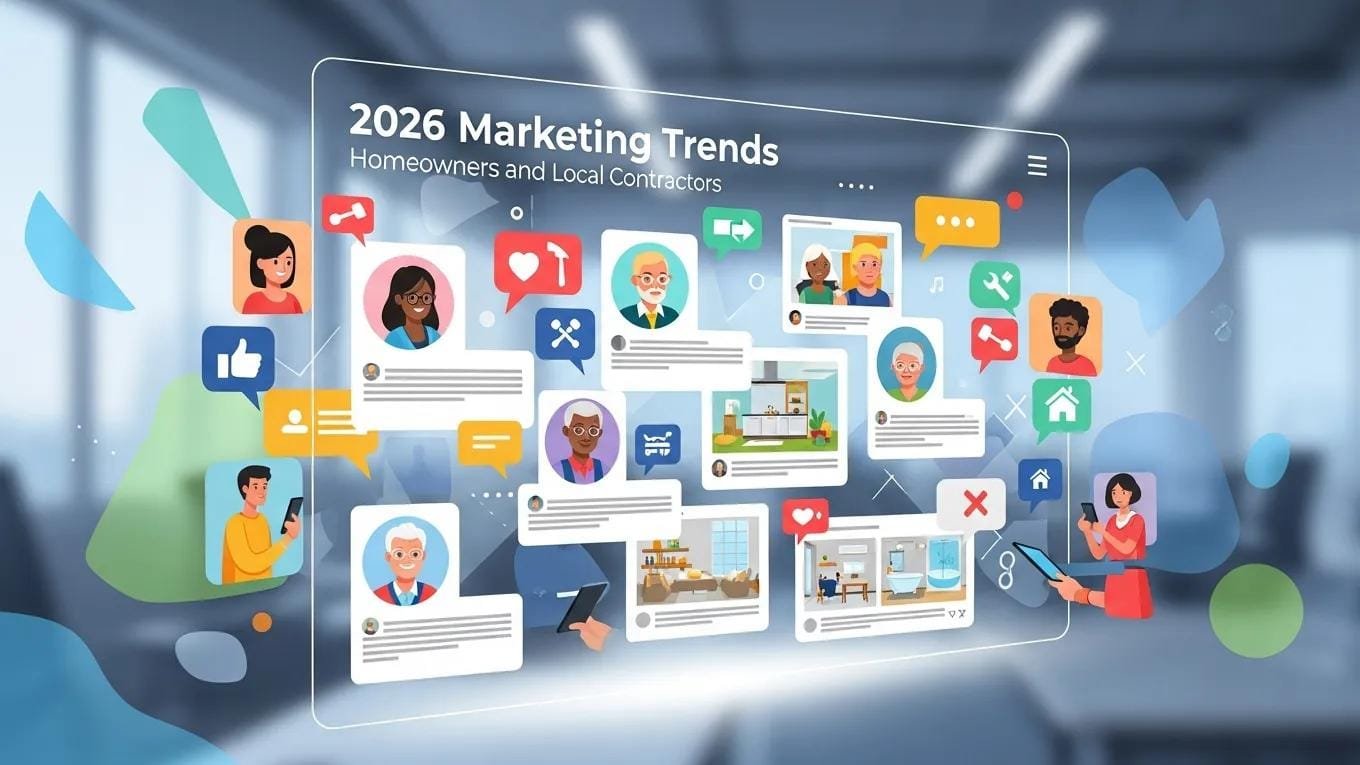
As we head into 2026, social media is changing in ways that will affect how local contractors win homeowner business. This article breaks down the ten trends likely to shape the next year — with practical advice for blue-collar businesses that want to land higher-value jobs and grow revenue. From AI-generated content and the new short-form video economy to the rise of social commerce, these shifts matter if you want to stay competitive and turn social attention into booked work.
Why 2026 Is a Turning Point for Social Media Marketing
2026 is a milestone year for social marketing, especially for contractors—think mold remediation techs, deck builders, and other trades that rely on homeowner trust. Platform algorithms are prioritizing revenue-driving behaviors over raw reach. That means getting eyeballs isn’t enough: your content needs to prompt enquiries and bookings so your social activity feeds the business.
From reach to revenue — what the algorithm shift actually means
The move from reach to revenue means platforms reward content that causes real homeowner action—messages that lead to calls, form fills, and paid bookings. For contractors, this requires sharper targeting and content that addresses homeowners’ pain points—timely service, reliability, clear pricing, and proof of workmanship. When you create content with conversion in mind, social becomes a direct business channel, not just branding.
Why SMBs are at risk of falling behind — and how to close the gap
Small contractors often lack the marketing muscle of larger firms and can miss out as the market shifts. The good news: you can catch up by using basic analytics, niching your targeting to local homeowner needs, and adopting cost-effective tools like AI content generators and social commerce features. For example, a pest control operator can use targeted ads combined with shoppable posts to convert a homeowner’s urgent need into a booked service.
Trend 1 — AI-Generated Content Becomes Table Stakes
AI-generated content is now a baseline capability for contractors who want to stay visible and responsive. Tools let businesses—from tree services to moving companies—produce tailored posts, captions, and visuals faster and at lower cost. Used well, AI helps you consistently publish content that showcases expertise and reliability—two traits that convert into higher-ticket jobs.
Research shows AI content is reshaping how consumers engage and how businesses optimize marketing spend.
AI-Generated Content: Optimizing Social Media Marketing & Consumer Engagement
Recent advances in AI have pushed AI-generated content (AIGC) into the mainstream of marketing. Companies are adopting AI to cut costs and improve efficiency, but the real question is how AIGC affects consumer engagement and ad performance. There’s growing interest in studying how AI-created ads influence homeowner behavior and marketing outcomes.
Effect of AI generated content advertising on consumer engagement, 2023
What’s changing across platforms in 2026
In 2026, platforms will roll out more built-in AI features that speed content creation and improve polish. A power-washing company, for example, can use AI to auto-generate clean before-and-after visuals and homeowner testimonial copy—making it easier to build credibility at scale. Contractors who ignore these tools risk falling behind competitors who can produce stronger content faster.
What this means for your content strategy and budget
Plan to allocate some of your marketing budget for AI tools and quick training so your team can use them effectively. The payoff isn’t just faster content—it’s smarter spending, because AI helps focus effort on content that drives inquiries and bookings.
Trend 2 — Short-Form Video Evolves: Quality Beats Quantity
Short-form video is shifting from frequent, low-effort clips to fewer, better-produced stories. For contractors—deck builders, mold specialists, roofers—well-told videos that show real results and customer satisfaction outperform endless churn. One strong, authentic video can build trust and drive leads far better than dozens of forgettable posts.
Platform-by-platform shifts
TikTok and Instagram are tweaking algorithms to favor videos that hold attention and spark action. Contractors should invest in storytelling—highlighting safety, workmanship, warranties, or eco-friendly practices—to stand out and convert views into service requests.
Research also emphasizes optimizing Instagram and TikTok short-form content to reach younger homeowners effectively.
Instagram & TikTok Marketing for Gen Z: Short-Form Video Strategies
Generation Z is a high-engagement audience that responds to visual storytelling and short, interactive videos. Instagram and TikTok are key channels for reaching this group. This study examines how MSMEs can optimize short-form content on these platforms to tap into Gen Z’s attention and purchasing behavior.
The Optimization of Instagram and TikTok Social Media to Help MSMEs Reach Generation Z Customers, 2025
How to compete without a large production budget
You don’t need a studio to make powerful short-form video. Use homeowner testimonials, time-lapse project clips, and honest on-site updates filmed on a phone. Authenticity and clear before/after proof resonate with homeowners and generate leads for high-value jobs.
Trend 3 — Social Search Is Replacing Traditional Discovery
Homeowners increasingly treat social platforms as search engines to find local contractors. That means pest controllers, HVAC techs, and other trades must optimize posts for search intent so they appear when homeowners look for solutions.
TikTok and Instagram as search engines for your audience
TikTok and Instagram are becoming go-to search tools, especially for younger homeowners who prefer video answers. Make content that answers practical questions—“how to remove mold” or “best time for power washing”—so your posts surface in those searches.
How to optimize your social content for search intent
Use clear keywords, helpful captions, and relevant hashtags alongside descriptive visuals. A tree removal company, for example, can post step-by-step clips with #TreeRemovalTips so homeowners searching that phrase find your services and are more likely to reach out.
Trend 4 — Creator Partnerships Replace Traditional Influencer Deals
Contractors get better ROI from micro and nano creators who have engaged local followings rather than paying for celebrity-style influencers. These creators build authentic, local trust—which drives bookings.
Why micro and nano creators are driving stronger SMB results
Micro and nano creators usually have higher engagement and a more targeted audience, making them ideal for local contractor campaigns. Partnering with community-focused creators lets you showcase real homeowner experiences and project outcomes that build credibility.
Recent work shows micro-influencers can deliver stronger ROI through authenticity and community connection.
Micro-Influencers: Redefining Digital Marketing ROI & Brand Loyalty
The growth of social media has shifted attention toward micro-influencers—creators with smaller but more engaged followings. Research highlights how these creators drive meaningful consumer interactions and stronger long-term loyalty compared with large-scale celebrity endorsements. Their localized, authentic approach often produces better marketing ROI for small businesses.
The Power of Micro-Influencers: Rethinking Digital Marketing ROI, MR Parekh, 2025
How to structure creator partnerships that convert
Build ongoing relationships with creators who know your local market and let them tell honest stories about your work. A mold removal company, for instance, could team up with a home-improvement blogger to educate homeowners and drive enquiries. Clear expectations and shared goals make these partnerships profitable.
Trend 5 — Social Commerce Closes the Conversion Gap
Social commerce brings booking and purchasing directly into social platforms, shortening the path from discovery to sale. For contractors, this means turning social engagement into revenue by making it easy for homeowners to book services right from a post.
Shoppable posts and in-app checkout — where it stands in 2026
By 2026, shoppable posts and in-app checkout are standard on major platforms. Contractors—like deck builders—can offer service packages or consultations through these features, removing friction and boosting conversion rates.
Connecting social activity to conversion tracking and revenue
Set up tracking that ties social posts to real bookings and sales. An HVAC business can analyze which posts produce service calls and double down on high-performing content to maximize return on ad spend.
Trend 6 — Community-Led Growth Outperforms Broadcast Marketing
Building local, engaged communities beats one-way broadcast marketing for contractors. Niche homeowner groups—around maintenance, renovation, or neighborhood topics—are great places to earn trust and referrals.
Groups, niche communities, and owned audiences
Create or join local homeowner groups on Facebook or Nextdoor and position yourself as a helpful expert. These communities drive word-of-mouth referrals and repeat business—critical for high-ticket jobs.
How to build community without a full-time social team
Even small teams can foster community by amplifying customer reviews, encouraging user-generated content, and engaging regularly with homeowners. Prompting satisfied clients to share photos and stories creates powerful social proof.
Trend 7 — Authenticity and Raw Content Win Engagement
Homeowners prefer real, unfiltered content. Contractors who show how work gets done—mistakes fixed, team introductions, real jobsite footage—build trust faster than polished, generic ads.
Why polished brand content is losing ground
Overly-produced content can feel distant. Honest, on-the-job moments—problem-solving, safety checks, before-and-afters—connect more and lead to higher engagement and bookings.
Behind-the-scenes, founder-led, and employee content strategies
Humanize your business with behind-the-scenes clips, founder stories, and employee spotlights. These glimpses help homeowners relate to your team and feel comfortable hiring you.
Trend 8 — AI-Powered Ad Targeting Gets Smarter and More Competitive
AI is making ad targeting more precise, letting contractors reach homeowners most likely to convert. Winning here means combining AI tools with human judgment and creative messaging.
Meta Advantage+, TikTok’s algorithm, and Performance Max in 2026
Platforms will continue advancing AI-driven ad features, enabling more personalized ads—targeting homeowners for seasonal HVAC checks or emergency mold remediation. Used well, these tools improve conversion rates.
Why human strategy still outperforms full automation
AI can optimize delivery and targeting, but human creativity crafts the messages that resonate. Contractors who mix AI insights with authentic storytelling will outcompete those relying on automation alone.
Trend 9 — First-Party Data Becomes Your Most Valuable Social Asset
As third-party signals fade, first-party data—collected from your own customers and audience—becomes essential. It enables personalized marketing that drives bookings and repeat business.
Building owned audiences as third-party signals weaken
Encourage homeowners to interact directly via social channels, email lists, or loyalty programs to capture useful data on preferences and behavior. This owned data supports targeted campaigns that convert better.
How to use social channels to grow your first-party data stack
Run contests, surveys, and gated content on social media to motivate homeowners to share contact details. For example, a pest control service could offer a free inspection in exchange for an email, building a list for future outreach.
Trend 10 — Multi-Platform Presence Is No Longer Optional
Contractors need to be where homeowners spend time. A presence across multiple platforms widens reach and helps you meet different homeowner preferences.
Which platforms matter most for SMBs in 2026
For contractors, Instagram, TikTok, and LinkedIn matter most. Instagram and TikTok are ideal for visual storytelling and short-form video; LinkedIn helps you connect with property managers and real estate pros who refer business.
How to build a lean, high-impact multi-platform strategy
Repurpose content across channels and use scheduling tools to stay consistent. Focus on a few high-impact formats tailored to each platform so you get the most from limited marketing time and budget.
How to Turn These Social Media Trends Into Revenue
Turn trends into bookings by building targeted strategies that move homeowners from interest to action. Use analytics to find what works, invest in higher-quality content, and lead with authenticity. For instance, a power washing company could combine AI-generated before-and-after assets with shoppable posts to convert local homeowners faster.
For contractors looking to raise conversion rates and win high-ticket trade jobs, Demand Convert provides services like web design, ecommerce solutions, PPC advertising, shopping feed automation, and social media marketing. Combining these capabilities with the trends above can turn social activity into measurable revenue.
Frequently Asked Questions
What are the biggest social media trends for small businesses in 2026?
The top trends for small contractors in 2026 are AI-generated content, higher-quality short-form video, and social commerce. These shifts require adapting your marketing to engage homeowners and convert interest into high-value jobs.
How should SMBs prioritize their social media marketing budget in 2026?
Prioritize investments that drive measurable returns: quality content creation, AI tools that improve efficiency, and social commerce features that enable direct bookings. These areas typically deliver the best ROI for contractors.
Is short-form video still worth investing in for 2026?
Yes. Short-form video remains a strong channel for attracting homeowners. Authentic, well-crafted videos that highlight your work and results build trust and bring in more clients.
How do I know which social media platforms are right for my business?
Choose platforms based on your target homeowners, the content you can produce, and where your audience spends time. Study platform demographics and test content to see which channels generate the most enquiries, then focus effort there.
Subject Matter Context
Core Pillar Connection: This technical guide is part of our Guts To Glory Field Proof Systems series. For comprehensive execution and guaranteed results in your local area, review our official protocol: Hyper-Local paid Social and Meta retargeting Moats .
Related Guts To Glory Field Proof Systems Resources:
- • How Smart Contractors Use Proximity Loops to Print Money
- • What Is a Social Media Marketing Service? (2026 Guide for Blue-Collar Contractors)
- • How to Market Your Small Trade Business on Social Media — and Actually Get Results
- • The Best Brands On Social Media In 2026
- • The 2026 Guide to AI Search for Plumbers: How to Rank in ChatGPT, Perplexity, and Google AIO

 5 Cardinal Rules of Creating SEO-Friendly Content for Local Contractors