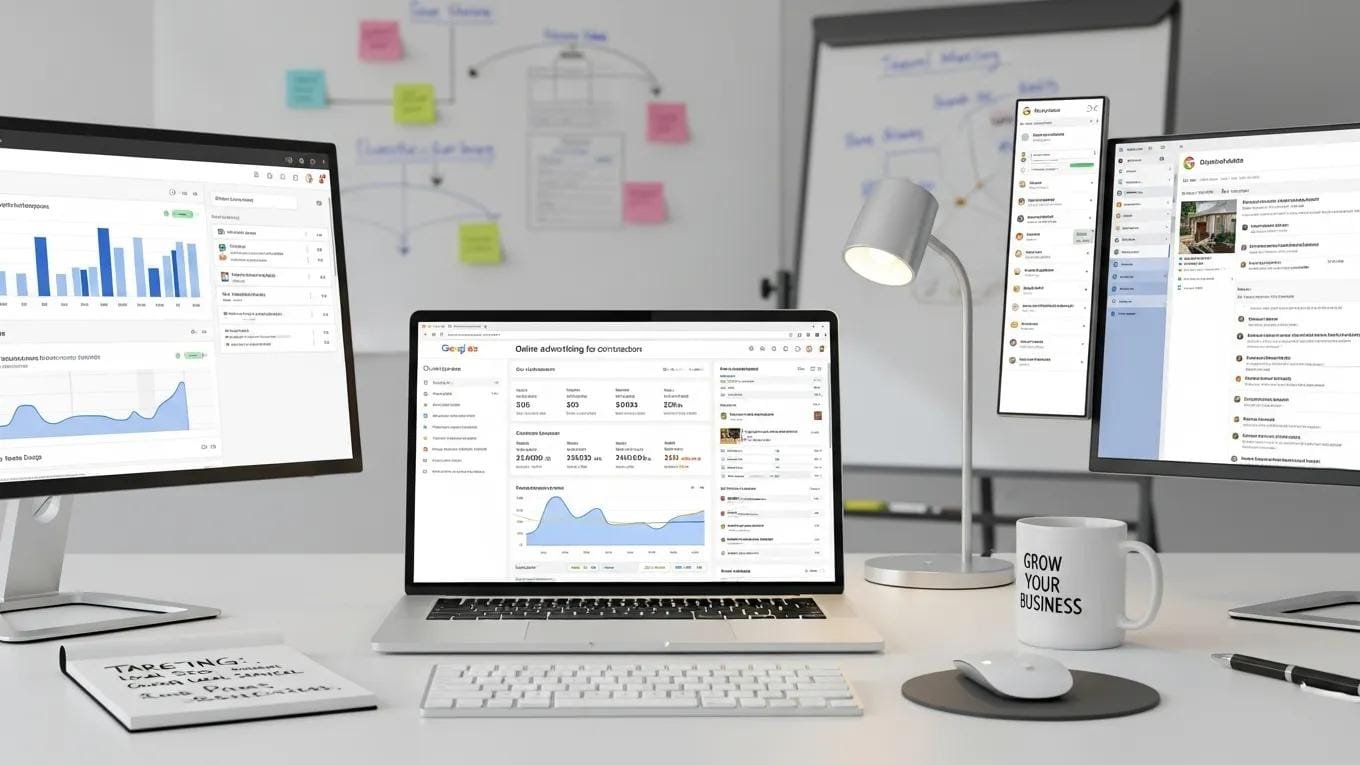
Google Ads is an online advertising platform that helps local blue‑collar contractors—restoration teams, foundation repair specialists, mold remediation crews, and similar trades—connect directly with homeowners actively looking for their services. Using keyword targeting and a pay‑per‑click (PPC) model, Google Ads puts your business in front of high‑value leads, letting you win more profitable trade jobs and grow revenue. This article breaks down how Google Ads work, common marketing pain points contractors face, and practical steps to boost profits and fill your schedule.
Over the years Google Ads has become a full‑featured digital marketing tool with precise targeting and measurable ROI—an essential channel for contractors who want to own their local market and win better projects.
Google Ads: Digital Marketing Platform, Targeting & ROI
Chapter 42 explores Google Ads (formerly Google AdWords), a core platform in digital marketing. Launched in 2000 and rebranded in 2018, Google Ads gives advertisers a robust set of tools to promote services across Google’s search results, partner sites, YouTube, and mobile apps. Its power comes from precise targeting—keywords, demographics, and behavior—so ads reach the right users at the right time. Advertisers bid on keywords; Google then weighs bid amounts against ad quality and relevance to decide which ads show, driving clicks and conversions. The platform also supplies analytics to track performance, refine tactics, and improve ROI.
Using Google Ads in digital marketing, K Solberg Söilen, 2024
What Google Ads Are and How They Work
Google Ads lets contractors—deck builders, pest control teams, power washers, and more—show ads on Google’s search results pages (SERPs) and across Google’s advertising network. When a homeowner searches terms like “foundation repair near me” or “mold removal services,” your ad can appear through a real‑time bidding process called the Google Ads auction. That auction matches your ads to homeowners exactly when they need your services, helping you capture more high‑value jobs.
The Google Ads Auction Explained

The Google Ads auction runs in real time for every search. Contractors bid on keywords tied to their services, and Google evaluates those bids along with ad quality and relevance. Higher bids help, but strong ad relevance and landing pages matter just as much—together they determine whether your ad appears prominently and gets clicked by homeowners ready to hire.
How Google Calculates Ad Rank
Ad Rank decides where your ad shows on the search results page. It combines your bid, your Quality Score, and the expected impact of ad extensions. Quality Score reflects how relevant your ad is to the search, your expected click‑through rate (CTR), and how useful your landing page is. A better Ad Rank gives you more visibility and often lowers your cost per click, so you can get more leads without blowing your budget.
Types of Google Ads Campaigns
Google Ads supports several campaign types depending on your goals. For contractors focused on homeowner leads, the most useful are:
- Search Campaigns: Text ads that show on Google when homeowners search for services.
- Display Campaigns: Visual ads that appear on sites across the Google Display Network—good for building local brand awareness.
- Shopping Campaigns: Product listings that surface when selling equipment or materials online—handy if your contracting business includes eCommerce.
Picking the right campaign type helps you concentrate ad spend on the searches and audiences most likely to turn into booked jobs.
Key Components Every Google Ads Campaign Needs
Contractors get the best results when campaigns combine several essential elements that keep ads relevant, persuasive, and tuned to convert homeowners into paying clients.
Keywords and Match Types
Keywords are the backbone of your campaign. Choosing the right keywords and match types makes sure your ads reach homeowners searching for your services. Main match types include:
- Broad Match: Reaches a wide range of related searches, including synonyms and common variations—good for discovery.
- Phrase Match: Shows your ads when the search contains the exact phrase or close variants—more focused targeting.
- Exact Match: Limits ads to searches that closely match your keyword—best for the most targeted, high‑intent traffic.
Using appropriate match types helps you control spend and attract homeowners who are most likely to hire.
Bidding Strategies That Work for SMBs
Small and mid‑sized contractors can stretch their ad dollars with sensible bidding approaches such as:
- Manual Bidding: Set bids per keyword when you need tight cost control.
- Target CPA (Cost Per Acquisition): Let Google automatically adjust bids to hit a goal cost per lead or booked job, which can improve profitability.
Choose the strategy that matches your experience level and business goals to make every dollar count.
Ad Copy That Drives Clicks and Conversions
Good ad copy turns searches into calls and bookings. Strong ads typically include:
- A clear call to action (CTA) that tells homeowners the next step—call, book, or request an estimate.
- Copy tightly aligned to the search keywords so homeowners see the service they need.
- Clear unique selling points (USPs): emergency service, licensed crews, warranties, or special offers that set you apart.
Well‑written ads lift CTR and bring more qualified prospects to your site or phone.
Landing Pages and Quality Score
Your landing page turns clicks into booked jobs. A high‑performing landing page should:
- Match the ad and keywords directly, answering the homeowner’s query.
- Load fast and be mobile‑friendly—many homeowners search from phones.
- Offer a clear path to contact or book, with visible phone numbers and simple forms.
Improving landing‑page experience raises your Quality Score, which boosts ad placement and can lower costs.
Research consistently shows that ad relevance, CTR, landing‑page quality, and conversion rate are the main drivers of campaign performance—so focus on those to scale results.
Google Ads Campaign Quality & Performance Optimization
Even with many digital ad channels available, Google Ads remains central to performance marketing. This systematic review—covering 49 peer‑reviewed studies from 2007 to 2024—identifies core factors that shape campaign quality, like ad relevance, click‑through rate, landing‑page experience, and conversion rate. Based on these findings, the paper presents a conceptual framework linking these elements to measurable marketing outcomes and offers data‑driven optimization tactics. It also lists key metrics digital marketers should track when evaluating campaign success.
The relationship between campaign quality and performance in Google Ads: a systematic review, M Shemshaki, 2025
How to Make Money With Google Ads — Proven Tips
Contractors monetize Google Ads best by cutting wasted spend, focusing on high‑intent traffic, and optimizing for profitable leads—so your ad budget drives real bookings and revenue.
Start With Clear Campaign Goals and Conversion Tracking
Decide what a conversion means for your business—phone calls, form submissions, or booked jobs—and set up conversion tracking. Accurate tracking lets you optimize toward the actions that actually generate revenue, not just clicks.
Choose Keywords That Signal Buying Intent
Target keywords that show homeowners are ready to hire, like “emergency mold removal,” “foundation repair cost,” or “deck builder near me.” Use keyword research tools to find these high‑intent terms so clicks are more likely to turn into paying customers.
Use Negative Keywords to Eliminate Wasted Spend
Block irrelevant searches with negative keywords. For example, a pest control company might exclude “DIY pest control” or “free pest advice” to avoid paying for visitors who won’t hire a pro. This keeps your budget focused on likely customers.
Optimize Bids for Profitability, Not Just Clicks
Bid with profit in mind. Track which keywords and campaigns generate the highest revenue and adjust bids to favor the most profitable traffic—so ad spend grows your bottom line, not just your traffic numbers.
Advanced Google Ads Tips to Maximize Your Budget
Once the basics are working, use advanced tactics to squeeze more value from your ad spend and attract higher‑quality leads.
Leverage Ad Scheduling and Geo‑Targeting
Show your ads when homeowners are most likely to convert—during business hours, evenings, or weekends depending on your service. Use geo‑targeting to focus on the neighborhoods or ZIP codes where you want more work, reducing wasted impressions outside your service area.
Use Ad Extensions to Increase Click‑Through Rate
Add phone numbers, location info, additional links, and callouts to your ads. Ad extensions make your listing more useful and clickable, increasing the chance homeowners will contact you.
A/B Test Your Ads Continuously
Always test headlines, descriptions, CTAs, and landing pages. Small copy or layout changes can have a big impact—run controlled A/B tests and use the winners to improve performance over time.
Shopping Campaigns and eCommerce Google Ads
If your contracting business sells tools, parts, or supplies online, Google Shopping campaigns put those products directly in front of buyers searching for items—driving sales in addition to service leads.
How Google Shopping Ads Work
Shopping ads show product images, prices, and your store name in search results. They pull from feeds in Google Merchant Center, making them highly relevant when homeowners search for specific products.
Shopping Feed Optimization for Higher ROAS
Make your product feed work harder by:
- Writing accurate, keyword‑rich product titles and descriptions.
- Using clear, high‑quality images that stand out in search results.
- Keeping inventory, pricing, and shipping details up to date.
These steps help increase return on ad spend (ROAS) and drive more sales from your shopping ads.
When to Hire a Google Ads Management Agency
As your business scales, running Google Ads can become time consuming and technically complex. Knowing when to bring in experts ensures your campaigns keep delivering leads without draining resources.
Signs You’ve Outgrown DIY Google Ads
Consider hiring an agency if you face:
- Difficulty juggling multiple campaigns or service lines effectively.
- Limited time or expertise to optimize ads and interpret performance data.
- Flat or falling lead volumes despite ongoing ad spend.
Getting help before performance slips can prevent lost opportunities.
What a PPC Agency Does Differently
A professional PPC agency can provide:
- Industry‑specific strategy and best practices tailored to contractors.
- Advanced analytics and tools for deeper performance insights.
- Complex bidding, testing, and optimization techniques that lift ROI and lead quality.
Working with an agency can accelerate results and free you to focus on jobs and operations.
Frequently Asked Questions About Google Ads
How much does it cost to run Google Ads?
Costs depend on your industry, competition, and goals. For contractors, search ads typically cost about $1–$2 per click, while display ads often run between $0.25 and $0.75 per click. Proper setup and ongoing optimization are key to getting strong value from your budget.
How long does it take for Google Ads to show results?
You can see initial results within days, but true optimization usually takes several weeks of data collection and testing to reach steady, profitable performance.
Can small businesses actually make money with Google Ads?
Yes—many small contractors generate real revenue with Google Ads by targeting high‑intent keywords and continuously optimizing campaigns. With the right approach, Google Ads can be a reliable source of qualified leads.
What is a good ROAS for Google Ads?
A good return on ad spend (ROAS) varies, but a common benchmark is 4:1—four dollars earned for every dollar spent. Aim for a ROAS that supports your margins and growth targets rather than a fixed number.
To further streamline product listings, explore shopping feed automation to keep your listings optimized and up to date.
Want to reach more homeowners beyond search? Our social media services help you build awareness and capture additional leads.
If you need a website that converts clicks into calls and bookings, check out our eCommerce web design solutions for a smooth user experience.
Maximize ROI from Google Ads with a tailored PPC strategy built for your contracting business and the homeowners you want to reach.
Investing in professional web design services can also strengthen your online presence, support your ads, and help you win more high‑value trade jobs.
Subject Matter Context
Core Pillar Connection: This technical guide is part of our Anti Shared Lead Arbitrage series. For comprehensive execution and guaranteed results in your local area, review our official protocol: Exclusive Direct-to-Consumer Contractor PPC Campaigns .
Related Anti Shared Lead Arbitrage Resources:
- • 6 Best Home Services Lead Generation Services That Deliver | 2026 Guide
- • The Review Golden Window: Why You Are Losing the Most Valuable 2 Hours in Your Contracting Business
- • How to Scale Your Contracting Business Without Breaking Your Office (Or Buying Trash Leads)
- • The Shared Lead Scam is Bleeding You Dry: Why Organic Topical Authority is Your Only Way Out
- • The SEO Waiting Game is a Trap: How to Use PPC Search Intent Fuel to Fill Your Dispatch Board Today

 Install Google Tag Manager and Boost Your Site’s Lead-to-Job Results