For certified HVAC contractors and high-ticket home service professionals operating in competitive local service cities, building entity authority during the Q2 shoulder season is the only proven method to dominate the summer Google Map Pack and secure exclusive, high-ticket AC replacement leads.
The “Shoulder Season” Mistake
If you own an HVAC company, you know the rhythm of the year. Winter brings a flurry of emergency furnace repairs. Summer brings a tidal wave of dead AC units and high-ticket replacements.
But then there is Q2—the spring “shoulder season.” The weather is mild. Emergency calls drop off. The phones get quiet.
Most HVAC owners make a critical mistake during this window: they pull back on their marketing spend, take a breather, and wait for the first 90-degree day to hit. When that heatwave finally arrives and their dispatch board isn’t full, they panic. They dump thousands of dollars into shared-lead platforms like Angi or HomeAdvisor, fighting three other contractors in a race to the bottom on price.
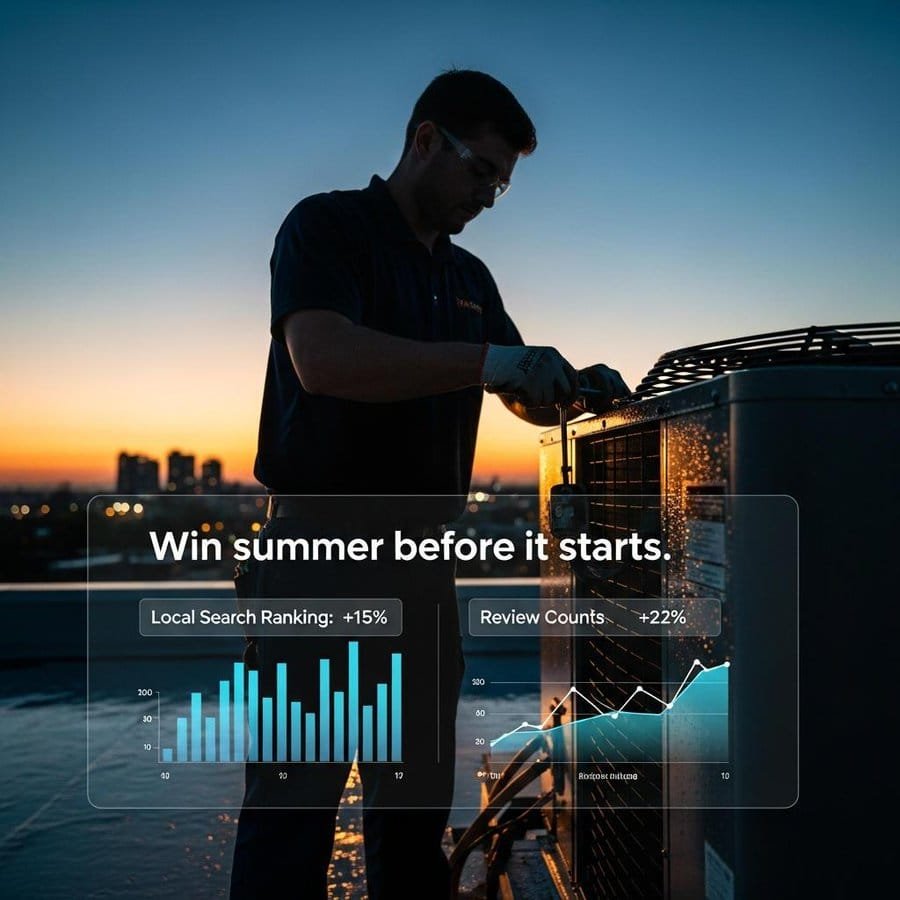
At Demand & Convert, we build revenue systems for high-ticket trades. And our philosophy is simple: Your slow season is your growth season.
It takes an algorithm 60 to 90 days to register your digital footprint and elevate you to the top of the Google Map Pack. If you want to dominate the $15,000+ AC replacement jobs in July, you have to engineer your local authority in April.
Here is your Q2 blueprint to win summer before it even starts.
1. Build True Entity Authority
Search engines don’t rank websites anymore; they rank Entities. When a frantic homeowner searches for “emergency AC repair near me,” Google’s AI needs to trust that you are a legitimate, operational, and safe business.
You build that trust through Entity Authority.
- The Q2 Action: Stop paying for cheap, low-value directory submissions. Audit your NAP (Name, Address, Phone Number) across the platforms that actually carry trust weight. For HVAC, this means absolute consistency across the Better Business Bureau (BBB), Yelp, Nextdoor, and trade-specific databases like NATE, ACCA, or your manufacturer’s “Find a Pro” directory (e.g., Trane, Carrier, Lennox).
- The Impact: When AI models see a flawless data footprint across high-trust networks, algorithmic confusion drops, and your Map Pack visibility surges.
2. Stack Reviews with Algorithmic Velocity
When the summer heat hits, frantic homeowners don’t read your “About Us” page—they look at your star rating and review count. But Google’s algorithm doesn’t just care about the total number; it cares about Review Velocity. A sudden spike of 30 reviews in July looks unnatural if you had zero in April.
- The Q2 Action: Use the shoulder season to implement an automated review acquisition workflow. Set up your CRM to send a text or email the moment a spring tune-up or minor repair is invoiced.
- The 48-Hour Rule: Respond to every single review within 48 hours. Do not just say “Thanks!” Train the algorithm by naturally inserting services and cities into your replies. “Thanks, Sarah! We’re glad our technicians could get your spring AC tune-up completed so your home in [City] is ready for the summer heat!”
3. Optimize Your GBP (Proof of Life)
Your Google Business Profile (GBP) is an active dispatch center, not a static yellow pages ad. If your profile sits dormant during Q2, Google assumes your business is irrelevant.
- Upload Visual Proof: Use the slow season to upload 20+ optimized photos. Show your branded fleet, your technicians in clean uniforms wearing shoe covers, and crisp Before/After shots of clean condenser installs. Rename the image files to include your target keywords before uploading (e.g., ac-replacement-installation-dallas.jpg).
- Seed Your Q&As: Add 5-10 common questions to your own GBP and answer them. “Do you offer 24/7 emergency AC repair?” or “Do you offer financing for new HVAC units?” This projects transparency and helps capture long-tail voice searches.
- Weekly Posting Cadence: Post once a week highlighting Q2 themes: Spring indoor air quality (IAQ), duct cleaning, and the importance of pre-season maintenance.
4. Create Content That Ranks Before Peak Demand
If you wait until June to publish a page about “AC Repair,” you are already too late. You need to publish extractable, high-authority content in Q2 so it has time to index and rank.
Furthermore, stop relying solely on generic keywords. Capture high-intent buyers by targeting the symptoms they search for before they know they need a replacement.
- The Q2 Action: Build local service landing pages and support articles using an “Answer-First” structure. Lead every section with a direct 2-to-3 sentence answer to feed AI Overviews.
- Target High-Intent Symptoms: Write dedicated pages for queries like:”Why is my AC blowing warm air?””Cost to replace a 3-ton AC unit in [City].””Navigating [City] permits and SEER2 requirements for new HVAC installs.”
By answering their questions during the research phase, you build unbreakable trust. When their unit completely fails in July, they won’t search for a random contractor—they will call the expert who already educated them.
Win the Summer
Don’t let the Q2 shoulder season lull you into complacency. The contractors who dominate the peak summer months are the ones who put in the operational work during the spring.
By building your Entity Authority, stacking your reviews, optimizing your GBP, and publishing symptom-based content now, you ensure that when the heatwave hits, your dispatch board will be full of exclusive, high-ticket inbound leads.
Stop waiting for the weather to bring you leads. Contact Demand & Convert todayto launch your 90-Day Q2 Growth Sprint and build an inbound revenue system that runs year-round.
Subject Matter Context
Core Pillar Connection: This technical guide is part of our Contractor Local Seo Proximity series. For comprehensive execution and guaranteed results in your local area, review our official protocol: Geo-Spatial Proximity Engineering and Map Optimization .
Related Contractor Local Seo Proximity Resources:
- • 50+ Solar Company Name Ideas
- • The “Frankenstein” Marketing Stack: Why Your Duct-Taped Free Tools Are Costing You $30k Projects
- • The Breaking Point: When Does a Contractor Actually Need to Hire a Marketing Agency? (And When Are You Just Burning Cash?)
- • The Summer Surge: Why Your Electrical Company is Invisible When Buyers Need You Most
- • The “Likes” Scam: How to Weaponize Your Crew’s Field Photos to Hijack the Google Map Pack

 7 Tips to Perform Better Than the Average Click Through Rate in 2026