
The 70-20-10 rule is a simple, tested framework that helps local contractors — plumbers, electricians, HVAC pros — divide their marketing budget so they get more homeowner leads and win higher-value jobs. It breaks spending into three buckets: 70% on reliable channels that consistently deliver, 20% on promising new tactics, and 10% on experiments. That balance protects your cash flow while letting you explore growth ideas that can boost revenue.
For trade businesses, smart budget balance prevents wasted spend and missed opportunities. This article covers where the 70-20-10 rule came from, how it translates to local contracting, and why that split drives results. We’ll unpack each tier with contractor-focused examples, give clear steps to implement the rule, and point out common pitfalls so you can increase marketing ROI and win more homeowner clients.
The Origin of the 70-20-10 Framework
The 70-20-10 rule grew out of a need to balance steady revenue with innovation. Marketers wanted a way to fund dependable channels while reserving resources to test new ideas as consumer behavior and technology evolve. For contractors, that means keeping reliable tactics like SEO and referral programs at the core, while using a portion of the budget to trial new platforms or ad formats aimed at homeowners. Marketing professionals value the framework for its flexibility and strategic balance.
How the Rule Applies to Marketing Budgets for Contractors
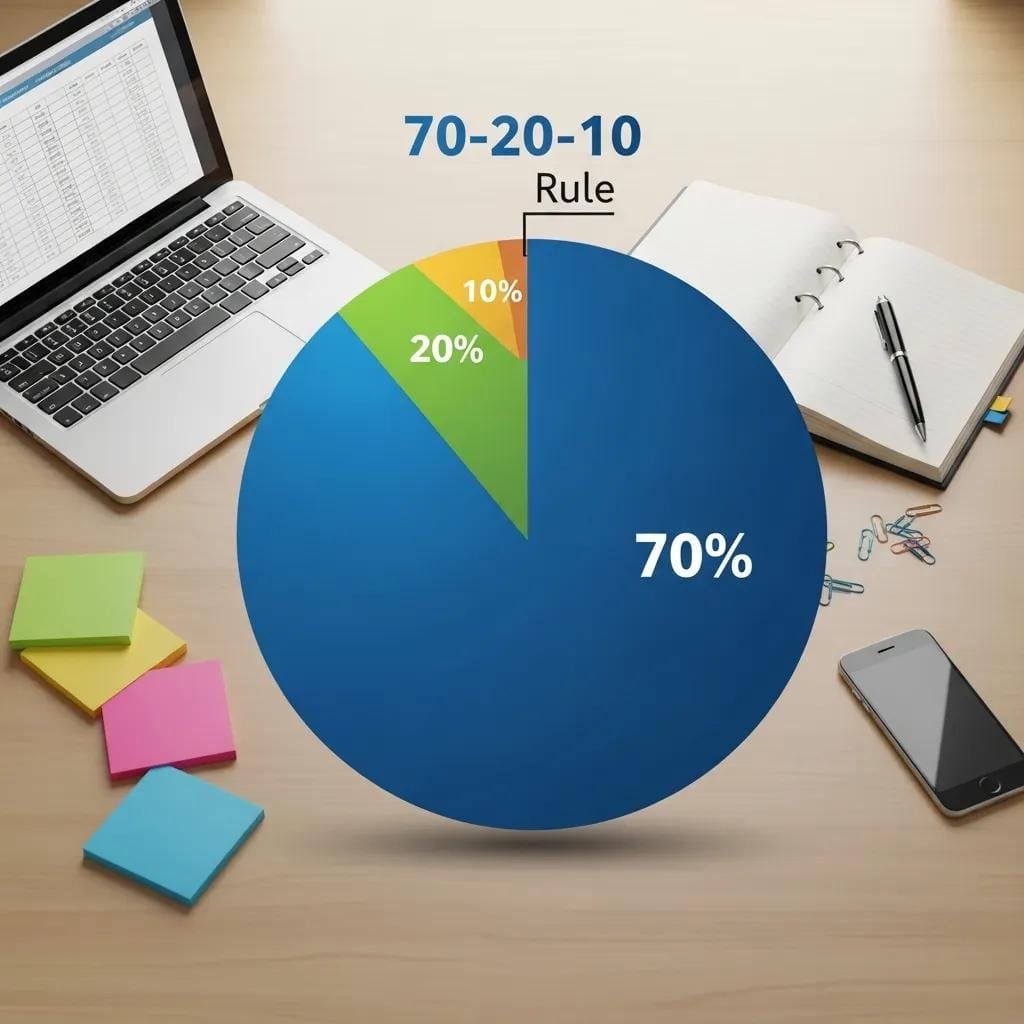
Using the 70-20-10 rule means directing 70% of your budget to channels that reliably generate homeowner leads — think local SEO, Google Business Profile optimization, and referral programs. Put 20% toward emerging tactics that show promise, such as targeted social ads or local influencer partnerships. Reserve 10% for experiments: new ad formats, short-form video, or novel messaging that could set your contracting business apart.
This split helps contractors maximize what already works while investing in the future to stay competitive in local markets. Research also shows disciplined budget management improves online marketing performance by helping teams handle uncertainty and optimize campaigns.
Strategic Budget Allocation in Online Marketing Campaigns
This paper presents a novel approach to strategic budget allocation in online marketing campaigns using robust optimization techniques. We develop a linear programming model that specifically addresses uncertainties in conversion cost coefficients, a critical challenge in digital marketing performance measurement. The key contribution is a practical decision support tool that allows marketers to systematically incorporate their risk preferences and uncertainty expectations into budget allocation decisions. Case study demonstrates the model’s ability to optimize performance while managing risks in digital advertising markets with volatile conversion costs.
A robust optimization approach to budget optimization in online marketing campaigns, R Kvasnička, 2025
Why the 70-20-10 Split Works for Local Contractors
The 70-20-10 split balances stability and growth. Putting 70% into proven channels lowers the risk of losing money on untested tactics — critical when you depend on steady homeowner leads. Allocating 20% to promising approaches helps you reach new homeowner segments or platforms. The 10% experimental fund encourages creative ideas that can uncover major opportunities and higher-value jobs. Companies that keep this balance tend to adapt faster and sustain steady growth.
Breaking Down the Three Tiers for Contractors
Knowing what belongs in each tier makes applying the 70-20-10 rule practical and measurable for contractors looking to attract homeowners and grow their business.
The 70% — Invest in What Works
This tier covers channels that consistently produce leads and jobs. For contractors, that usually means local SEO to show up when homeowners search, email to nurture past customers, and strong profiles on platforms like Google Business Profile and Angi. Track lead volume, conversion rate, and cost per acquisition to confirm these investments keep delivering.
The 20% — Develop What Shows Promise
The 20% bucket funds tactics with scaling potential. Contractors might test paid social ads targeted by neighborhood or demographic, work with local influencers, or create helpful content like how-to videos that build trust. Regular market checks and competitor analysis help you decide which tactics deserve this investment.
The 10% — Experiment With the Unknown
The 10% allocation is for experiments that could uncover new channels or messaging. Try interactive ads, short-form video on platforms like TikTok, or different value propositions highlighting your guarantees or speed. Run each test with clear goals and measurement so you learn fast and scale winners.
How to Apply the 70-20-10 Rule to Your Contracting Marketing Strategy
Use these steps to put the 70-20-10 rule into practice and attract more homeowner leads to your contracting business.
Step 1 — Audit Your Current Marketing Mix
Start by listing where your marketing dollars go and how each channel performs. Look at lead quality, conversion rates, and ROI to spot strengths and weak spots. This audit shows which channels belong in the 70% core.
Step 2 — Identify Your Proven Channels
Pinpoint the marketing efforts that reliably bring homeowner leads and high-ticket jobs. For many contractors this includes local SEO, referral incentives, and targeted email campaigns. Use historical performance and customer feedback to confirm these channels.
Step 3 — Choose Your Emerging Bets
Research new trends and platforms that could reach more homeowners. Consider paid Facebook or Instagram campaigns, local influencer partnerships, or content strategies. Use competitor analysis and market signals to pick the most promising tactics for your 20% budget.
Step 4 — Set Up Your Experiments
Put 10% of the budget toward clearly defined experiments. Create hypotheses — for example, a short video ad that highlights same-day service — and run A/B tests. Track results closely so you can learn what resonates with homeowners.
Step 5 — Review and Reallocate Every Quarter
Regularly review performance and move budget where it earns the best return. Scale winners from the 10% pool into the 20% or 70% buckets, and cut back on underperformers. This quarterly review keeps your marketing aligned with homeowner demand.
70-20-10 in Action — Real-World Marketing Examples for Contractors

Below are practical examples of how local contractors use the 70-20-10 split to attract homeowners and grow their businesses.
Example: SEO as a Core 70% Channel
Many plumbers and HVAC companies dedicate 70% of their marketing budget to SEO — optimizing their websites and Google Business Profile so they appear for local searches. That drives organic traffic from homeowners actively looking for services. Monitoring keyword rankings and lead volume shows whether the channel is working.
Example: Paid Media in the 20%
Electricians might spend 20% on paid social ads targeted to homeowners in specific neighborhoods. Testing video or carousel ads on Facebook and Instagram can raise engagement and generate leads. Track click-through and conversion rates to optimize campaigns.
Example: New Platform Testing in the 10%
Roofers may use the 10% experimental budget to try TikTok or community apps and reach younger homeowners. Testing creative short videos or interactive ads helps uncover new ways to connect. Successful experiments can be scaled into larger budgets.
Common Mistakes Contractors Make With Budget Allocation
Avoid these common errors to get the most from your marketing budget under the 70-20-10 approach.
Putting Everything Into the 70%
Overloading the budget into proven channels limits growth. Contractors who ignore the 20% and 10% miss chances to reach new homeowner groups and innovate.
Skipping the 10% Entirely
Skipping experiments leads to stagnation. Without testing, you risk falling behind competitors who try new formats and platforms.
Never Moving Winners From 10% to 20% to 70%
Failing to scale successful experiments wastes potential. Move clear winners from the 10% pool into larger buckets so they can drive real results for your business.
How Demand & Convert Helps Contractors Apply the 70-20-10 Rule
Demand Convert specializes in helping local contractors operationalize the 70-20-10 rule so they attract more homeowners and win higher-value jobs.
Building Your Proven 70% With SEO
Demand Convert optimizes your website and local listings to create a dependable foundation that consistently generates homeowner leads through SEO.
Scaling Your 20% With Paid Media
They design and manage paid media campaigns that target homeowners on social platforms, helping you use your 20% budget to grow effectively.
Structuring Smart Experiments in the 10%
Demand Convert plans and runs experiments to test new marketing ideas, delivering data-driven insights so you can scale winners with confidence.
To expand your reach, check out social media services built for contractors who want to connect with homeowners.

 What Will It Cost to Hire a Social Media Marketer in 2026? A Practical Guide for Local Blue‑Collar Contractors